Commentary

outputs_in

Commentary

23 April, 2025

Can Uzbekistan Withstand the Test of Gold Fever?

Last week, gold prices reached a historic high of USD 3,500 per ounce (31.1 grams). The growth of the cost of this resource on the world market is traditionally perceived as a positive factor, as it contributes to the strengthening of government reserves, increase in export revenues and other macroeconomic benefits. However, as the experience of several countries shows, raw material prosperity in the long term can turn into a factor that hinders economic development.   According to the Central Bank of Uzbekistan, the country’s gold reserves are estimated at 11.5 million troy ounces at the beginning of 2025. Uzbekistan is among the world’s leading gold producers: by the end of 2024, its annual production was about 105 tons, which ensures its place in the top ten of the global ranking.   It should be noted that Uzbekistan realizes both the potential benefits and risks associated with the current market environment. On the one hand, high gold prices provide the country’s economy with a significant fiscal and export bonus. On the other hand, the key issue is not the fact of rising prices, but how effectively the additional export revenues will be distributed.   Uzbekistan is currently taking measures aimed at rational use of the favorable market situation. A significant part of the raw material surplus is being channeled into long-term projects, including the development of education, health care and the technological sector. In parallel, investments are being made in non-resource sectors such as textiles, agro-processing, logistics and IT, which contribute to the creation of added value and new jobs.   Special attention is paid to social initiatives, including the Youth Notebook and Women's Notebook programs, which are digital platforms for targeted support of relevant categories of the population. The implementation of such projects not only contributes to social stability, but also reduces migration pressure, reducing the outflow of population to large cities and abroad.   Thus, the current rise in gold prices creates additional opportunities for Uzbekistan for economic transformation. The critical question remains whether it will be possible to avoid the “resource curse” that characterizes many commodity-based economies. Uzbekistan is demonstrating a desire not only to maximize revenues from gold mining, but also to diversify the economy through investments in human capital and innovative industries. Only time will tell how successful this strategy will be.   * The Institute for Advanced International Studies (IAIS) does not take institutional positions on any issues; the views represented herein are those of the author(s) and do not necessarily reflect the views of the IAIS.

outputs_in

Commentary

23 April, 2025

Bangladesh and Pakistan: A New Page in Relations

On 17 April 2025, Pakistan’s Foreign Minister Ishaq Dar visited Dhaka, Bangladesh, and held talks with her counterpart, Bangladesh’s Foreign Secretary Jashim Uddin. This was the first high-level diplomatic contact between the two countries since 2010.   Throughout Bangladesh’s creation as an independent state till the 2010s, relations between Pakistan and Bangladesh have been somewhat cordial. Pakistan officially recognized Bangladesh in February 1974, under Prime Minister Zulfikar Ali Bhutto. This came after the 1972 Simla Agreement and the release of Pakistani prisoners of war by Bangladesh. That same year, Bhutto visited Dhaka, where he expressed regret for the events of 1971 and talked about working together economically, although he didn’t give a formal apology.   Relations started to improve in the late 1970s and 1980s. In 1978, Pakistan gave Bangladesh four Shenyang F-6 fighter jets, showing signs of military cooperation. The two countries kept talking during President Muhammad Ershad’s time (1982–1990). He visited Pakistan in 1986, and during the visit, both sides discussed trade and regional cooperation. These discussions took place under the framework of SAARC, which had been founded in 1985. SAARC created opportunities for regional leaders like Ershad and Zia-ul-Haq to meet and engage. However, progress in Bangladesh–Pakistan relations was slow. One reason was that many in Bangladesh (especially the Awami League) remained focused on seeking justice for the events of 1971. They also preferred maintaining closer ties with India. A key moment came in July 2002, when Pakistani President Pervez Musharraf visited Dhaka; it was the first visit by a Pakistani head of state since 1974. At the Martyrs’ Monument, he expressed regret for the “excesses” of 1971. The BNP welcomed this, but the Awami League said it wasn’t enough. Furthermore, when Sheikh Hasina returned to power in 2009, relations got colder. Her government prioritized ties with India and started trials against people accused of helping the Pakistani military in 1971. Pakistan criticized the trials, calling them politically motivated. Even though trade reached $400-450 million, by 2010, high-level talks had mostly stopped.   New Elite. Bangladesh’s government changed in August 2024 when protests led by students forced out Prime Minister Sheikh Hasina. At the moment, Muhammad Yunus, a Nobel Prize laureate, leads an interim government. Yunus wants Bangladesh to have good ties with multiple countries, not just India. His interim government severed its ties with New Delhi when he criticized India for sheltering the overthrown Hasina and demanded her extradition. As a result, it opened up a space (chance) for Pakistan to get closer to Bangladesh. This change is not merely reactive; it shows a deliberate attempt to redefine Bangladesh’s national identity and foreign policy, moving away from India-centric dependence toward broader regional engagement.   Although an apology was asked for the 1971 war damages from Pakistan and the request was not met. However, it should not be seen as a condition from the Bangladeshi part to Pakistan in resetting their ties, because regardless two states seem desperate in reconnection. It can even be noticed in their discussion on reviving SAARC (South Asian Association for Regional Cooperation) – an ASEAN-like organization for the region.   Economic cooperation is a major reason for the renewed talks between Bangladesh and Pakistan. Their bilateral trade already exceeds $1 billion. Bangladesh exports garments, and Pakistan supplies cotton, rice, and wheat. Due to the new interim ruler, M. Yunus, in February 2025, they restarted direct trade with a large rice shipment, signaling stronger economic ties. Plans for direct flights, lessening visa procedures, are also in progress to boost connectivity.   China Factor. China’s influence quietly shapes this development. Pakistan remains a close ally of Beijing. Bangladesh depends on Chinese investment for infrastructure such as roads and ports. Pakistan and Bangladesh may align with China’s South Asian ambitions. Stronger ties between them could support China’s Belt and Road Initiative. Such alignment raises India’s concerns about a shifting regional balance. Meanwhile, India closely monitors these talks because its economic ties with Bangladesh have weakened: India recently canceled a transshipment deal. This disrupted Bangladesh’s $39 billion garment export industry.   Impact on CA. Pakistan’s role as a transit hub for Bangladeshi goods from Afghanistan could boost economic ties with Central Asian nations like Uzbekistan and Turkmenistan. Afghanistan serves as a gateway to Central Asia. Both nations already focus on this region. Enhanced cooperation might spark joint energy or infrastructure projects. Additionally, China’s Belt and Road Initiative could link Bangladesh and Pakistan to Central Asian markets. Thus, new trade routes may emerge.   By Firdavs Azimkulov   * The Institute for Advanced International Studies (IAIS) does not take institutional positions on any issues; the views represented herein are those of the author(s) and do not necessarily reflect the views of the IAIS.

outputs_in

Commentary

19 April, 2025

China’s Response to Donald Trump’s Tariff Policy

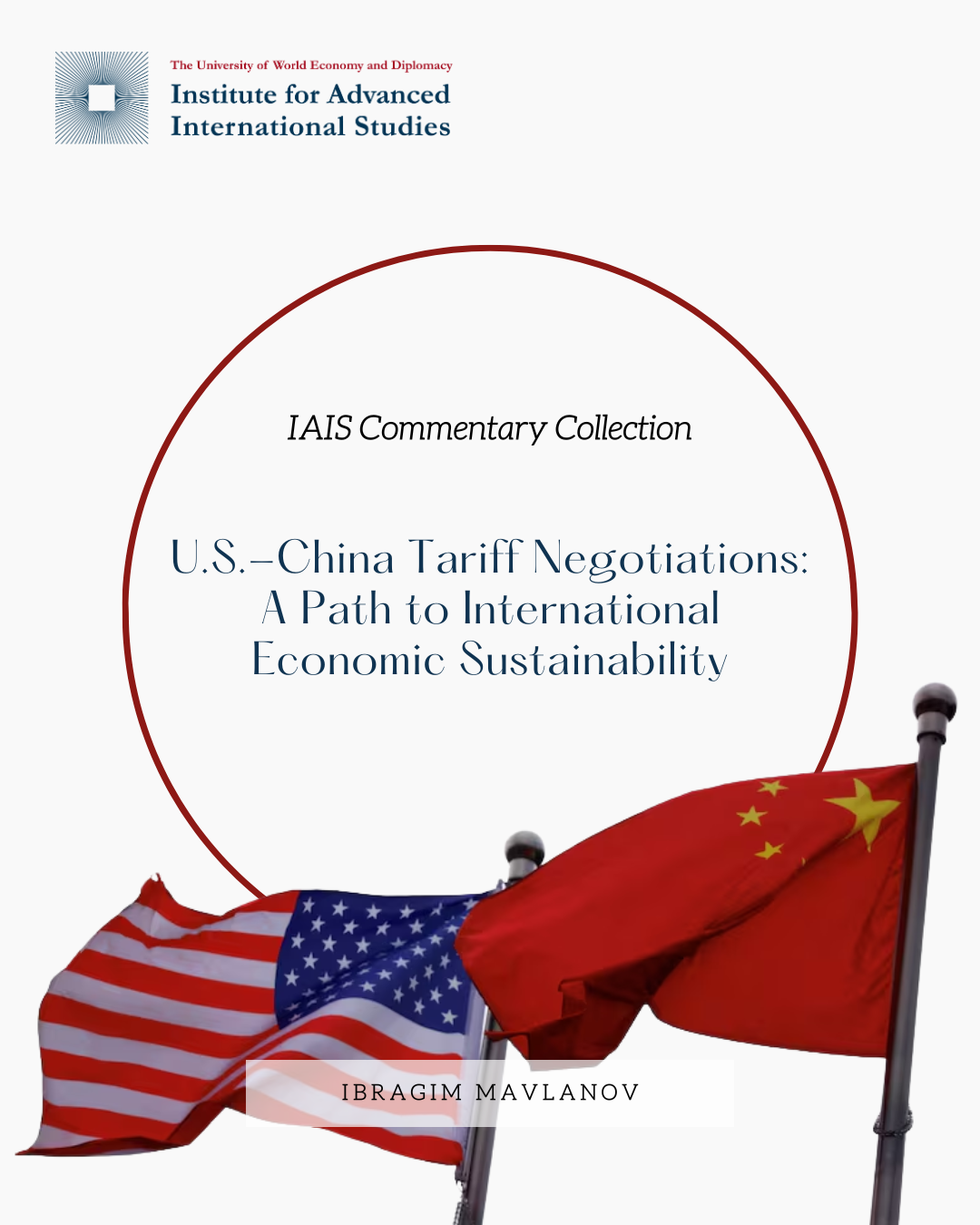
In recent months, we have witnessed the adoption of unprecedented tariff policies by the US to many countries that have trade surplus with the US, especially against China. Based on Donald Trump’s campaign speeches, it was known that he would adopt a tough trade policy towards Beijing when he came to power. The predictions came true, but the scale of the 145% duty hike on all Chinese goods, as well as the simultaneous adoption of mirror measures by the Chinese government with a 125% duty hike on U.S. goods, came as a surprise to many. By taking retaliatory measures, China has made it clear that it is not going to give in to threats from the US and will “fight to the end” in this trade war.   In turn, the White House threatened China with additional duty hikes of up to 245% for retaliating to Chinese actions. The Wall Street Journal reported that US President Donald Trump plans to convince more than 70 countries to isolate China’s economy in exchange for lifting duties on imports.   In response, Beijing has begun a gradual reorientation towards the markets of the EU, ASEAN and the One Belt, One Road (OBOR) initiative countries. Moreover, China has successfully shifted its production capacity to Southeast Asia and Mexico as part of its diversification of trade ties. Also in the face of high duties, Beijing has sent official letters to the governments of major nations affected by Washington’s duty hikes. In particular, active negotiations are being held with the eastern allies of the United States – South Korea, Japan and Australia, and from April 13 to 17 Xi Jinping’s tour of Southeast Asian countries – Vietnam, Malaysia and Cambodia – took place.   Along with this, attention should be drawn to the lack of willingness of Trump and Xi to make mutual compromises. At the beginning of Trump’s second term, attempts by Chinese representatives to establish direct channels of communication with Washington were unsuccessful, and the new White House administration is in no hurry to initiate negotiations with Beijing. The lack of stable communication channels between the leaders and their proxies creates a risk of further escalation of U.S.-China disagreements. It is not excluded that the subsequent steps of the parties will be mirror-like in nature, which will only complicate the prospects of launching full-fledged high-level negotiations.   Thus, taking into account the combined share of the U.S. and China in the world economy (about 43%), the scale and depth of the trade confrontation between the world’s two largest economies is reaching an unprecedented level. This could cause serious tensions in global trade with potentially negative consequences for the entire world economy, especially in terms of supply chain resilience. Given the new challenges, many countries are seeking to diversify their foreign trade relations, which leads to the revision and reformatting of the structure of world trade.   Analysts believe that the introduction of high tariffs will deal a particularly heavy blow to the economies of middle-income countries, whose sustainability depends largely on export revenues. In the near future, such countries may face capital outflow and lower growth rates. However, the prolonged trade friction between the U.S. and China also opens up new opportunities, such as attracting investment from both sides, creating joint production facilities, and developing alternative transportation and logistics routes.   * The Institute for Advanced International Studies (IAIS) does not take institutional positions on any issues; the views represented herein are those of the author(s) and do not necessarily reflect the views of the IAIS.
outputs_in

Commentary

19 April, 2025

Russia and the Taliban: Political Rapprochement

On April 17, the Supreme Court of the Russian Federation suspended the ban on the activities of the Taliban movement within the country. By this decision, Russia officially removed the Taliban from its list of terrorist organizations. Moscow’s motivations may lie in the following factors:   First, under conditions of international sanctions, Russia is prioritizing the development of relations with countries of the Global South, where Afghanistan plays a key role as a transit territory.    Second, Afghanistan may become a new export market for Russia. The two sides plan to increase their trade turnover to $3 billion this year.    Third, the Russian Federation is interested in Afghanistan’s substantial reserves of natural resources, including lithium, copper, and rare earth elements.    Fourth, Moscow may view the Taliban as an important partner in the fight against the terrorist network ISIS-Khorasan, especially following the events at Crocus City Hall.    Fifth, the political rapprochement between the Russian Federation and the Taliban may serve as a response to U.S. actions regarding Afghanistan, particularly the visit of former U.S. Special Representative for Afghanistan Zalmay Khalilzad to Kabul in March of this year.    Sixth, closer ties with Afghanistan may represent a component of the Russian Federation’s grand strategy on the Eurasian continent, within which Afghanistan is seen as a state of key strategic importance.   Russia’s removal of the Taliban from its list of terrorist organizations sets a precedent that may influence the positions of other states, particularly those currently adopting a wait-and-see approach. Specifically, Iran, Pakistan, and India may intensify their partnerships with Afghanistan. Moscow is signaling its willingness to engage in dialogue with a de jure unrecognized government, which could encourage other countries to pursue more flexible policies toward Kabul. In the long term, this development has the potential to weaken the Taliban’s international isolation.   Overall, the Russian Federation’s policy toward Afghanistan may, in certain respects, align with the interests of the Central Asian countries. One of the most significant elements in this regard is Moscow’s foreign policy perspective, which views Afghanistan as part of Central Asia. Russia could act as a partner in shaping a unified regional strategy toward Afghanistan.   * The Institute for Advanced International Studies (IAIS) does not take institutional positions on any issues; the views represented herein are those of the author(s) and do not necessarily reflect the views of the IAIS.
outputs_in

Commentary

19 April, 2025

Restrictions on U.S. Aid and Civil Society Development in Uzbekistan

The policy of the administration of U.S. President Donald Trump demonstrates a steady trend to reduce funding for international initiatives. As part of this strategy, the U.S. side is reconsidering the scope and direction of foreign aid, which is already having a tangible impact on specific programs, including projects in Uzbekistan. In particular, a $2.5 million U.S. State Department grant intended to stimulate civic engagement in the republic was recently canceled.   The U.S. Agency for International Development (USAID) plays a significant role in the structure of U.S. support. Since the opening of the USAID office in Tashkent in 2020, there has been a significant increase in its participation in the distribution of U.S. aid. By 2024, USAID's share is estimated to have increased from 24.2% to 73.5%, indicating an institutional strengthening of their presence in the country. However, in January 2025, Donald Trump issued an executive order temporarily suspending all foreign aid from USAID for 90 days to review programs for consistency with “American values” and U.S. national foreign policy priorities.   Such measures fit into the broader context of a return to isolationist attitudes and a revision of the principles of resource allocation in favor of domestic objectives. In this sense, the current steps of the administration cannot be considered unexpected: they are a continuation of Trump's pre-election rhetoric, which implies cutting government spending, strengthening control over international obligations and ideological filtering of foreign policy initiatives.   Nevertheless, the impact of these decisions on the development of civil society in Uzbekistan appears limited. The “New Uzbekistan” concept, proclaimed in 2021, consistently emphasizes institutionalization of public initiatives, strengthening the role of non-state organizations and expanding mechanisms for civic participation. In this context, international support, including U.S. support, acts more as an additional, but not a determining factor.   Consequently, even with the reduction of external grant funding, the development of civil society institutions in Uzbekistan remains internally sustainable, relying on the political will of the leadership and public demand for modernization.   * The Institute for Advanced International Studies (IAIS) does not take institutional positions on any issues; the views represented herein are those of the author(s) and do not necessarily reflect the views of the IAIS.