Commentary

outputs_in

Commentary

29 April, 2025

The UK in Search of a New Strategic Identity

UK policy since the beginning of 2025 has entered a phase of adjusting strategic priorities against the backdrop of a changing global configuration. The focus is on strengthening defence and trade and economic cooperation with the EU. This not only marks a reset of relations after Brexit, but also represents a subtle diplomatic manoeuvre aimed at not severing ties with Washington, while strengthening the autonomy of the European vector of British foreign policy.   The leading trend here is the priority of defence cooperation, which, in fact, becomes the entry point to a broader political and economic convergence. Support for Ukraine, the development of joint defence technologies and the participation of the British military-industrial complex in the mechanisms of the new EU defence fund (€150 billion) represent a pragmatic choice dictated by the need to adapt to the growing fragmentation of the transatlantic security architecture. It is particularly noteworthy that in the context of weakening US guarantees and an unstable global economy, it is security that becomes the basis for further integration steps.   London’s statement on “shared values” becomes symbolic, which, although it does not mention Trump directly, actually opposes his approach to international affairs —  unilateralism, tariff protectionism and deviation from climate commitments. The UK demonstrates its intention to act in unison with the EU in supporting Ukraine within its internationally recognised borders, protecting the global trading system and implementing the Paris Agreement. In doing so, it sends a clear message that the sustainability of the international order and multilateral engagement remain a priority.   However, such an active rapprochement with Brussels raises domestic and foreign policy dilemmas. Firstly, there is a risk of irritating Washington, especially if the incoming Trump administration again bets on a tough trade policy. Secondly, the British establishment must manoeuvre between the interests of British farmers, industrialists and hardline sovereignty supporters, which limits the scope for deep regulatory integration with the EU. The fact that London has made clear its unwillingness to lower standards in the food and car industries suggests a desire to preserve autonomy in critically sensitive sectors while seeking US easing.   The complexity of the UK's position is further exacerbated by the fact that the country essentially acts as a bridge between two competing economic and political centres — the EU and the US. This gives London certain opportunities to mediate and strengthen its own role on the world stage, but requires strategic consistency and diplomatic malleability. If the Starmer government manages to implement the outlined “defence cooperation – economic dialogue – climate solidarity” nexus, it could become a model for a new type of Europe+ relationship — without membership, but with deep cooperation in key areas.   In conclusion, the current reset in UK-EU relations is not just a tactical choice, but a response to shifts in the system of international relations itself. With the erosion of US global leadership and growing instability in Eastern Europe, it is regional alliances based on values, security and pragmatism that are becoming points of resilience. The UK, after a painful break with the EU, could once again become one of the pillars of European stability, provided it manages to maintain a balance between the transatlantic and continental dimensions of its policy.   * The Institute for Advanced International Studies (IAIS) does not take institutional positions on any issues; the views represented herein are those of the author(s) and do not necessarily reflect the views of the IAIS.
outputs_in

Commentary

29 April, 2025

How a Trade War Could Impact Oil Demand in China and the Global Energy Market

The escalation of trade and economic tensions between China and the United States could significantly affect the global oil market. According to industry analysts, if the conflict deepens and China’s economic growth slows, the increase in the country’s oil demand could be halved — from 180,000 barrels per day to 90,000 barrels per day. This decline would particularly affect the diesel fuel sector, heavily used in industry and transportation, as well as the petrochemical industry, which is closely tied to exports and manufacturing supply chains.   China traditionally plays a key role as one of the largest oil consumers in the world. According to the International Energy Agency (IEA), China accounts for about 15% of global oil demand, and any fluctuations in its economy are immediately reflected in global oil prices. However, as noted by Rystad Energy, the market has recently become less sensitive to geopolitical events — including the US-Iran nuclear talks and the ongoing conflict in Ukraine. This may be due to market participants pricing in long-term volatility and reacting less sharply to individual political developments than in the past.   Nonetheless, US-China relations remain a major source of uncertainty. In particular, the potential lifting of US sanctions against certain Chinese oil refineries is under discussion, which could stimulate crude oil imports and domestic refining activity.   On the other hand, seasonal factors favor price growth. Rystad Energy forecasts that during the summer months, the price of Brent crude oil could exceed $70 per barrel, mainly driven by seasonal increases in fuel consumption. As of April, Brent prices are hovering around $67, and any positive signals from China could support further price growth.   Thus, the trade war between the United States and China acts not only as a macroeconomic challenge but also as a structural risk for the oil industry, influencing demand dynamics from the world’s largest importer and refiner of oil. Amid geopolitical turbulence, China increasingly serves as a “barometer” through which market participants gauge the resilience of oil demand and the potential for future price growth.   * The Institute for Advanced International Studies (IAIS) does not take institutional positions on any issues; the views represented herein are those of the author(s) and do not necessarily reflect the views of the IAIS.

outputs_in

Commentary

29 April, 2025

Central Asian Countries Approved Water Withdrawal Limits for the Growing Season 2025: Outcomes of the 89th ICWC Meeting

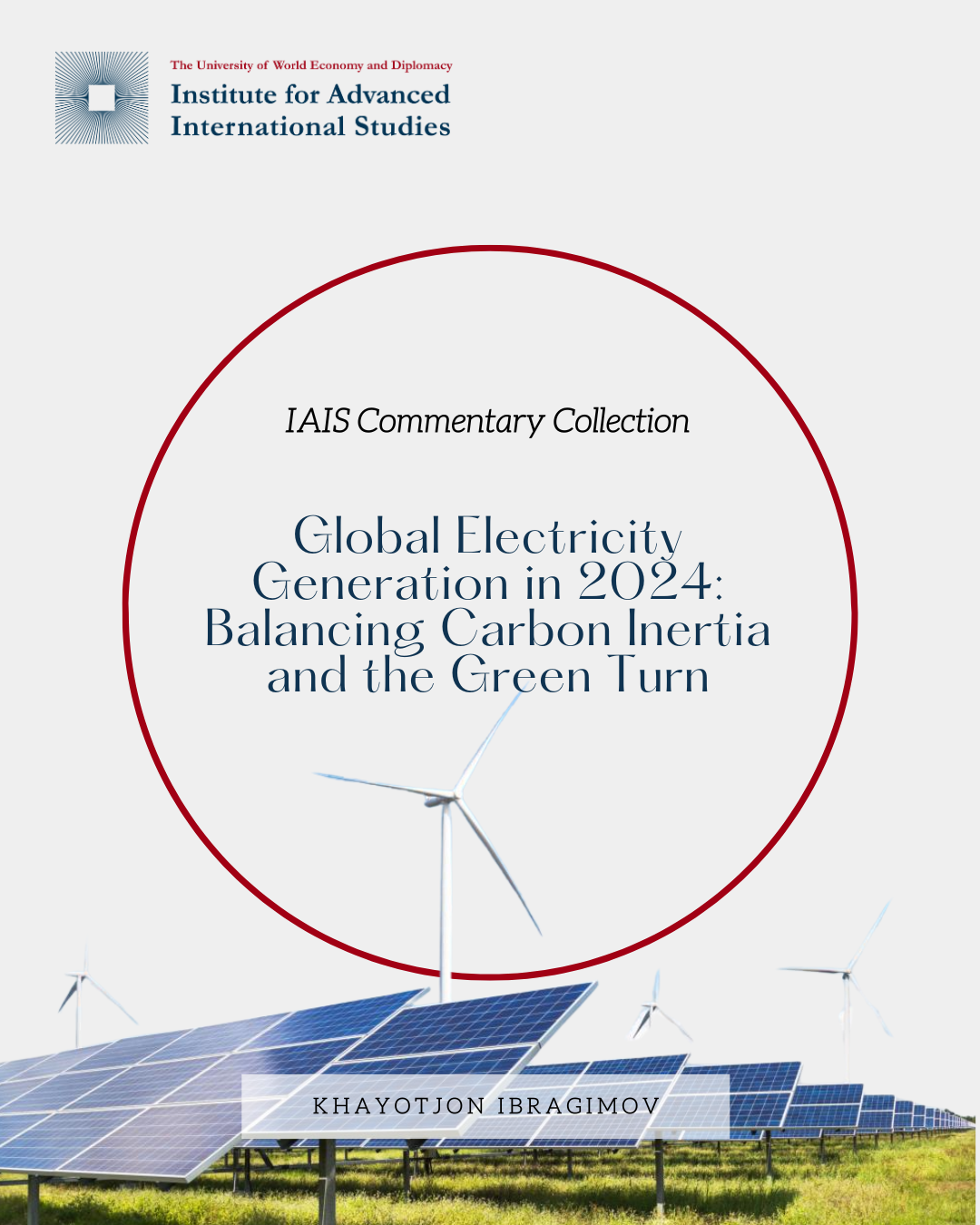
The Central Asian countries continue to strengthen the water management system based on a proactive institutional approach. The 89th meeting of the Interstate Commission for Water Coordination (ICWC) was held in April this year in Samarkand. One of the priority issues on the agenda of the meeting was the approval of agreed interstate water withdrawal limits for Central Asian countries for the growing season 2025 in the Syrdarya and Amudarya river basins.    Water withdrawal limits of the countries for the growing season 2025 in the Syrdarya river basin were approved in the following volume: Kazakhstan (Dustlik canal) – 909 million cubic metres; Kyrgyzstan – 270 million cubic metres; Tajikistan – 1.9 billion cubic metres; Uzbekistan – 8.8 billion cubic metres.   Water withdrawal limits for the growing season 2025 for the Amudarya river basin totalled 39.723 million m³ in total, of which Tajikistan accounts for 7.003 million m³, Turkmenistan — for 15.500 million m³, and Uzbekistan — for 16.020 million m³. Additionally, 5.150 million m³ of water is allocated for ecological and sanitary-ecological needs, including water supply to the river delta and the Aral Sea.   The meeting also confirmed the readiness of the Central Asian states to deepen the institutional framework for cooperation, where the emphasis was placed on improving the contractual and legal framework of the International Fund for Saving the Aral Sea (IFAS) and participation in international initiatives and strengthening the capacity and image of IFAS in the international arena. In this context, ICWC members were also tasked to assist in the organisation of a regional forum within the framework of the High-Level Interstate Conference on Glacier Conservation scheduled for 29-31 May 2025 in Dushanbe, Tajikistan.   These joint efforts reflect the aspirations of the Central Asian countries to effectively manage shared water resources, balancing the needs of agriculture, energy production and environmental conservation. It is worth noting separately that water reserves in upper reservoirs by the beginning of the growing season have increased by 1.47 billion m³ compared to 2024, which creates an additional resource buffer.   All this forms a steady trend: from technical synchronisation to institutional strengthening and strategic coordination. It is in such decisions that the practical value of water diplomacy — as a basis for environmental and political stability in Central Asia - is manifested.   Regular meetings reaffirm the strategic importance of transboundary water use coordination for sustainable development in Central Asia. Under conditions of changing climate and uneven water availability in the region, water diplomacy is transforming from a declarative slogan into an applied tool for joint regional management. The next, 90th ICWC meeting is planned for August 2025 and will be held in Astana, Republic of Kazakhstan.   * The Institute for Advanced International Studies (IAIS) does not take institutional positions on any issues; the views represented herein are those of the author(s) and do not necessarily reflect the views of the IAIS.
outputs_in

Commentary

28 April, 2025

The Impact of Trade Duties on Foreign Companies in China

The Financial Times, referring to the fact that “many manufacturers are forced to pay duties on both imports and exports”, focuses on foreign manufacturers in China, which are forced to pay duties of 125% on imports of components and then 145% on exports to the U.S., thus twice falling under the impact of trade duties from the U.S., which, as noted undermines their activities.   It should be noted that it is not only Chinese companies that have been hit, but also American companies doing big business in China. This is due to the fact that there are a number of foreign companies operating in China that are not American but rely on American raw materials, which puts them in the position of having to pay both American and Chinese duties on the same goods. At the same time, “some large American manufacturers, including smartphone makers and some electronics manufacturers, have secured temporary relief from Trump”.   According to China’s General Administration of Customs, “wholly or partly foreign companies in the country last year accounted for $980bn of Chinese exports, or more than a quarter, and $820bn of imports, or more than a third”, and that “China recorded a record trade surplus of nearly $1 trillion in 2024”. An important factor is that China’s export mechanism has been driven in whole or in part by foreign companies that have sought to take advantage of China’s huge and inexpensive labour market to produce goods.   * The Institute for Advanced International Studies (IAIS) does not take institutional positions on any issues; the views represented herein are those of the author(s) and do not necessarily reflect the views of the IAIS.
outputs_in

Commentary

26 April, 2025

The Influence of Power Polarization on Global Politics

In his commentary, Miraziz Masharipov, member of the IAIS Volunteers Club, argues that international relations today are being fundamentally reshaped by growing power polarization, creating a more chaotic and unstable world order. He explains that the traditional global political architecture is eroding, particularly with the return of Donald Trump to the U.S. presidency, which has accelerated existing trends. Mr. Masharipov points to three key dynamics behind this transformation: the emergence of non-traditional technological hubs, the deepening ideological gap between ultra-right and ultra-left forces, and an escalating conflict among global elites.   The author first highlights how technological power is shifting away from traditional centres like Silicon Valley to new hubs in China, India, Vietnam, Brazil, and Africa. He tells how these regions are not merely adopting but actively reshaping the future of technologies such as AI, quantum computing, and decentralized infrastructure. Yet, he warns, the expansion of these hubs is threatened by issues such as state overreach, as seen in China, and brain drain from emerging economies. This technological decentralisation, he suggests, will undermine Western leadership in setting global standards by 2030.   He then turns to the worsening ideological polarisation, particularly between ultra-right and ultra-left forces in Europe and the Americas. Mr. Masharipov describes how populist movements have eroded the traditional centrist consensus that once underpinned multilateral cooperation, with Trump’s nationalist policies further encouraging fragmentation. He argues that the paralysis within the EU and the rise of nationalist governments have weakened responses to major crises like the war in Ukraine and climate change, thereby turning international politics into a dangerously unpredictable arena.   Finally, the author discusses the evolving conflict among elites, focusing on Trump’s approach to foreign policy. He tells how Trump, unlike Biden, has chosen to engage authoritarian leaders like Vladimir Putin and Kim Jong Un through personal diplomacy, positioning himself as a global dealmaker. He contends that this style of transactional leadership prioritises personal relations over institutional norms, thereby exacerbating the fragmentation of global governance. In conclusion, Mr. Masharipov paints a bleak picture of a world increasingly dominated by technological decentralisation, ideological extremism, and elite rivalries, all of which threaten to unravel the already fragile international system.   Read on Paradigma.uz   * The Institute for Advanced International Studies (IAIS) does not take institutional positions on any issues; the views represented herein are those of the author(s) and do not necessarily reflect the views of the IAIS.
outputs_in

Commentary

25 April, 2025

The Migration Crisis Between Afghanistan and Pakistan

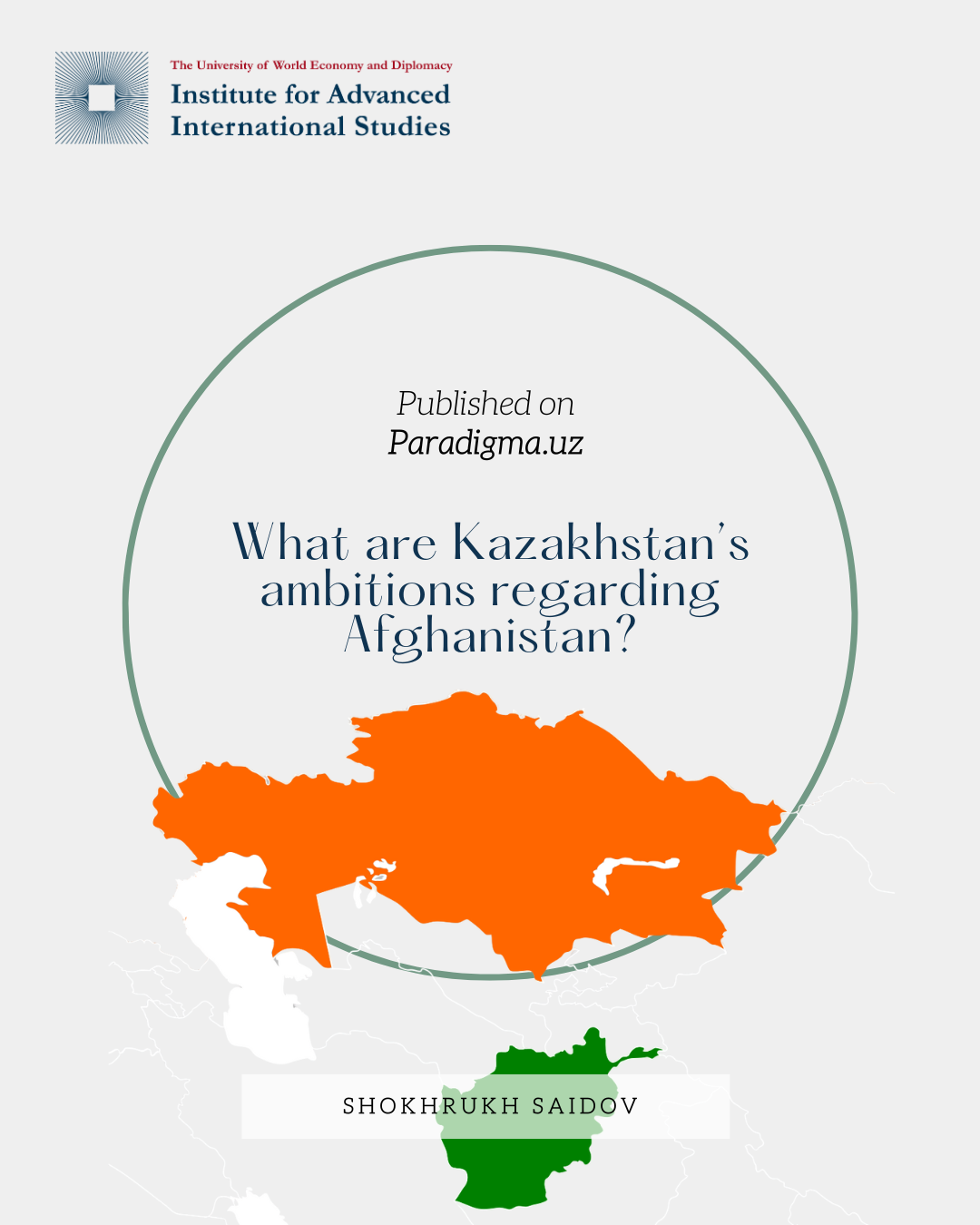
In April 2025, the Government of Pakistan launched an initiative titled the “Return to Homeland,” which was characterized by the Taliban administration as an act of “forced deportation.” As a result, nearly 80,000 Afghan nationals were deported through the Torkham border crossing in Pakistan’s Khyber Pakhtunkhwa province within the span of one month. According to the United Nations High Commissioner for Refugees (UNHCR) and other sources, between 19,000 and 45,000 of these individuals were forcibly expelled, while the remainder returned voluntarily or under minimal pressure.   The primary justification for the deportation process has been Pakistan’s internal security concerns. The heightened activity of terrorist organizations such as ISKP and Tehrik-e-Taliban Pakistan (TTP), along with cross-border militant movements and threats posed by criminal groups, have constituted key factors influencing this policy. During the first ten days of March 2025, five major terrorist attacks occurred in Pakistan—three in Khyber Pakhtunkhwa and two in Balochistan. All five were suicide bombings, resulting in the deaths of at least 18 individuals, including 12 military personnel, five Chinese nationals, and one Pakistani citizen. While such attacks have occurred in prior years, the deaths of Chinese citizens are particularly sensitive, as China remains one of Pakistan’s most crucial economic partners. The incident has consequently strained bilateral relations.   In response to these challenges, the Pakistani government initiated the "Illegal Foreigners Repatriation Plan" (IFRP), grounded in both security and political considerations. While this strategy seeks to bolster domestic security and regulate migration, it has also raised serious humanitarian and regional stability concerns.   Afghanistan, on the receiving end of these deportations, now faces significant challenges. Thousands of individuals who had resided in Pakistan for many years are now expected to reintegrate into a homeland marked by weak infrastructure and a deteriorated economy. Many of the returnees lack shelter, employment, and basic resources, rendering them vulnerable to recruitment by extremist organizations such as ISKP-Khorasan and TTP.   For the Taliban administration, this mass return could yield complex economic, political, and social repercussions. A considerable portion of the returnees are likely to migrate toward urban centers in search of employment, thereby straining already limited urban infrastructure. Failing this could result in rising unemployment, criminality, and public discontent that might severely undermine the internal stability of the country.   In turn, Iranians might also follow the Pakistan’s lead and begin to demand strict compliance with migration regulations from Afghan refugees residing within their territory, otherwise might undertake a massive deportation campaign similar to Pakistanis in near future.   At the same time, the international community has also begun to issue measured responses to the unfolding crisis. Notably, Qatar has launched a humanitarian initiative to support deported Afghan citizens by allocating $800,000 for the construction of housing in Gardez, the capital of Paktia province. Through such efforts—providing humanitarian assistance, supporting stability in Afghanistan, and mediating peace negotiations—Qatar appears to be solidifying its diplomatic standing in the international arena, particularly within the Muslim world, and positioning itself as a capable actor in resolving global crises.   In conclusion, the migration crisis along the border represents not merely a bilateral issue between Afghanistan and Pakistan but a significant challenge to broader regional security and stability. Its implications might extend to Iran, China, Central Asia, and other key regional stakeholders, influencing their political and security strategies since, migration policy of certain country reverberates across a complex system tied to human lives, stability, and international relations.   by Bobur Mingyasharov   * The Institute for Advanced International Studies (IAIS) does not take institutional positions on any issues; the views represented herein are those of the author(s) and do not necessarily reflect the views of the IAIS.