Media Appearances

outputs_in

Media Appearances

22 June, 2026

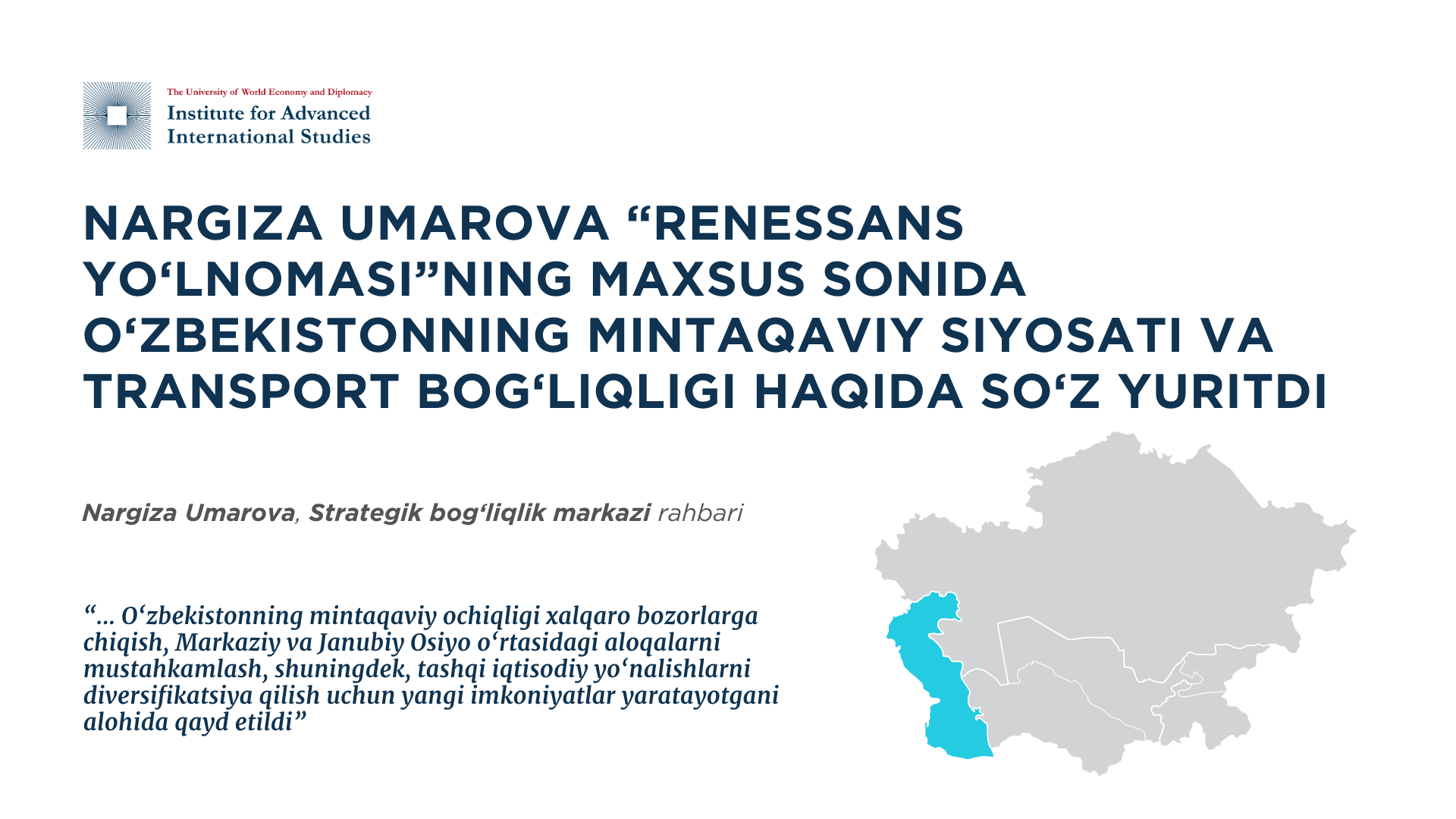
Nargiza Umarova Appeared on a Special Episode of “Rennesans yo‘lnomasi” on Regional Policy and Transportation Connectivity in Uzbekistan

Nargiza Umarova took part in a special episode of the “Rennesans yo‘lnomasi” program on Mahalla TV, dedicated to the transformation of Uzbekistan’s relations with neighboring countries in the region. During the discussion, particular attention was paid to how Tashkent’s updated foreign policy, based on trust, pragmatic dialogue, and the expansion of regional cooperation, has contributed to strengthening good-neighborly relations in Central Asia. In her remarks, Nargiza Umarova noted that the improvement in the political climate in the region has been a key factor in developing Uzbekistan’s transport connectivity with the outside world. Expanded cooperation with neighboring countries has made it possible to intensify efforts to modernize transport corridors, develop rail and road routes, and increase the country’s transit capacity. It was particularly emphasized that Uzbekistan’s regional openness creates new opportunities for accessing international markets, strengthening ties between Central and South Asia, and diversifying foreign trade routes. The expert’s participation in the program helped convey to a wider audience the importance of transport diplomacy and good-neighborly policies for Uzbekistan’s long-term development. * The Institute for Advanced International Studies (IAIS) does not take institutional positions on any issues; the views represented herein are those of the author(s) and do not necessarily reflect the views of the IAIS.

outputs_in

Media Appearances

15 June, 2026

China’s Poverty Alleviation Experience Offers Lessons and Confidence for Uzbekistan

The article examines how China’s large-scale poverty alleviation experience has become an important reference point for Uzbekistan as the country seeks to reduce poverty, expand employment, strengthen local development mechanisms and gradually build a broader middle class. It highlights that China’s success in lifting more than 800 million people out of poverty, as well as its targeted poverty reduction model, has attracted significant attention in Uzbekistan, particularly in the context of the country’s ongoing social policy reforms based on the principle of human dignity. The article pays particular attention to the growing practical cooperation between Uzbekistan and China in the field of poverty reduction. It notes the establishment of bilateral mechanisms, the signing of inter-agency memoranda, expert exchanges, pilot projects in Uzbekistan’s regions and the adaptation of China-inspired approaches such as infrastructure development, local industrialisation, entrepreneurship support, agricultural value chains and the “One Village, One Product” model. These initiatives are presented as part of Uzbekistan’s effort to develop its own national poverty alleviation model while drawing selectively on China’s experience. At the same time, the article emphasises that Uzbekistan is not simply copying the Chinese model, but adapting it to its own socio-economic conditions, administrative system and local realities. By combining China’s targeted poverty reduction methods with cooperation from international development institutions, Uzbekistan is seeking to build a more comprehensive and sustainable system of social support, grassroots governance and regional economic development, with the long-term goal of eliminating absolute poverty by 2030. Read on People’s Daily (China) * The Institute for Advanced International Studies (IAIS) does not take institutional positions on any issues; the views represented herein are those of the author(s) and do not necessarily reflect the views of the IAIS.

outputs_in

Media Appearances

19 May, 2026

Trans-Afghan Corridor, Termez Dialogue & Militancy: A Deep-Dive Conversation with Aziza Mukhammedova

On The Crossroads, Ali Adili, Non-Resident Policy Fellow with The Andiana Foundation and Non-Resident Fellow with New York University’s Center on International Cooperation, hosts Aziza Mukhammedova, Leading Research Fellow at the Centre for Afghanistan and South Asian Studies, for a deep-dive discussion on the evolving relationship between Afghanistan, Uzbekistan, and the wider Central–South Asian region. The conversation focuses on the Trans-Afghan Corridor, the Termez Dialogue, and Uzbekistan’s broader approach to regional connectivity, where Afghanistan is viewed not only through a security lens but also as a potential land bridge linking Central Asia with South Asia. The discussion also examines the major political and security constraints facing regional connectivity projects. Ms Mukhammedova highlights that the viability of the Trans-Afghan Railway depends on predictable relations between Kabul and Islamabad, while persistent security threats from militant groups continue to complicate long-term regional planning. Against this background, the conversation presents the Termez Dialogue as an emerging multilateral platform aimed at transforming Afghanistan from a source of regional uncertainty into a subject of structured dialogue, infrastructure cooperation, and economic interdependence. * The Institute for Advanced International Studies (IAIS) does not take institutional positions on any issues; the views represented herein are those of the author(s) and do not necessarily reflect the views of the IAIS.