Media Appearances

outputs_in

Media Appearances

29 January, 2026

Uzbekistan-China Cooperation at a New Stage: Political Trust, Economic Integration and Innovative Development

In recent years, Uzbekistan-China relations have consistently risen to a new level, deepening political trust and economic integration. Abbos Bobokhonov and Mokhinur Khasanova, an undergraduate student at UWED and an IAIS volunteer, noted that China is strengthening its position as one of Uzbekistan's largest trading partners and a leading investor, while Tashkent considers Beijing an important strategic partner in modernizing the national economy, enhancing infrastructure and industrial potential, as well as technological renewal. It is noted that the high-level meetings and sectoral consultations held during 2025 contributed to institutionalizing existing cooperation and strengthening practical effectiveness. The article emphasizes the stability of political dialogue: cooperation is being strengthened at the level of "comprehensive strategic partnership" through mechanisms such as regular meetings between President Shavkat Mirziyoyev and PRC Chairman Xi Jinping in 2025, the Intergovernmental Committee, and Strategic Dialogue between the Ministries of Foreign Affairs. Economic indicators are also cited as an important foundation for this process: in January-November 2025, trade turnover reached $14.6 billion, Chinese investments attracted in 2017-2024 amounted to $24.6 billion, and the portfolio of joint projects is expanding. The increase in the number of enterprises with Chinese capital and large industrial initiatives (including manufacturing and energy sectors) are cited as factors expanding the practical scope of cooperation. At the same time, the authors note the need for balanced development of cooperation in the next stage: deepening integration in innovation and education, expanding export opportunities, aligning standardization and certification mechanisms, and gradually reducing trade imbalances are put forward as priority tasks. The introduction of a 30-day visa-free regime from 2025 is expected to accelerate people-to-people relations, cooperation in tourism and education, and further strengthen mutual trust in the long term. Read on the website of the National News Agency of Uzbekistan “UzA” * The Institute for Advanced International Studies (IAIS) does not take institutional positions on any issues; the views represented herein are those of the author(s) and do not necessarily reflect the views of the IAIS.

outputs_in

Media Appearances

29 January, 2026

Five Years of Sadyr Japarov’s Presidency: Kyrgyzstan at the Threshold of a New Stage of Development

In an interview with the Kyrgyz news agency Kabar, Azamat Seitov offered an in-depth assessment of the first five years of President Sadyr Japarov’s tenure, describing this period as a turning point in Kyrgyzstan’s modern history. According to Seitov, Japarov assumed office at a time of profound political instability, weakened state institutions, and widespread public dissatisfaction. Over the past five years, however, Kyrgyzstan has managed to move away from chronic turbulence toward a more stable governance model, focused on strengthening state sovereignty, mobilizing domestic resources, and articulating a clearer strategic development agenda. A central part of the analysis is devoted to economic and institutional transformation. Seitov highlights steady GDP growth, a significant increase in the state budget, renewed investment activity, and the gradual restoration of public trust in government institutions. In his view, this period laid the foundations for a more predictable and resilient system of governance—an essential condition for long-term stability in a multiethnic society. The interview also places strong emphasis on foreign policy achievements, particularly the normalization and deepening of relations with neighboring Central Asian states. Seitov underscores the high level of mutual trust between the presidents of Kyrgyzstan and Uzbekistan, noting that direct and sustained leadership dialogue has become a key driver of regional stability and strategic cooperation. In his assessment, the country is now stepping into a new phase of its historical evolution, where regional stability is gradually becoming a norm rather than an exception. Read on Kabar * The Institute for Advanced International Studies (IAIS) does not take institutional positions on any issues; the views represented herein are those of the author(s) and do not necessarily reflect the views of the IAIS.

outputs_in

Media Appearances

29 January, 2026

China’s Investments in Central Asian Countries: Risks or Benefits

In an interview with Deutsche Welle, Abbos Bobokhonov describes Chinese direct investment in Central Asia as a rapidly growing trend, but one that is uneven in terms of quality and impact. Against the backdrop of a nearly twofold increase in China’s accumulated FDI in the region since 2016 and a concentration of investments in Kazakhstan, Uzbekistan, and Turkmenistan, the expert emphasizes that the dynamics are not “self-serving”: it reflects structural changes in the economic policies of the countries in the region and Beijing’s long-term foreign economic priorities. The expert links the growth of Chinese capital, first, to the logic of the Belt and Road Initiative, under which China invests primarily in sectors that directly serve its interests – infrastructure, energy, and industry. Second, he points to political and economic changes in the region: leadership changes in a number of countries have been accompanied by more liberal approaches to the economy and investment policy, which has increased the predictability and attractiveness of markets for Chinese investors. In his view, it is the combination of liberalisation and growing mutual trust that has widened the “window of opportunity” for scaling up projects. Speaking about risks, Dr. Bobokhonov makes an important distinction: the risk lies not in the investments themselves, but in poor project design and implementation control, including elements of corruption, which can lead to project failure and debt vulnerabilities. He also touches on a sensitive social aspect – the growth of critical sentiment and competition in local markets, against the backdrop of a sharp increase in the number of companies with Chinese capital. Read on Deutsche Welle * The Institute for Advanced International Studies (IAIS) does not take institutional positions on any issues; the views represented herein are those of the author(s) and do not necessarily reflect the views of the IAIS.
outputs_in

Media Appearances

13 January, 2026

Cooperation between Uzbekistan and China in the Field of Poverty Reduction

In an article published in the Chinese People’s Daily, Madina Alimova, a Leading Research Fellow at the Center for Asia-Pacific Studies, provides a detailed analytical overview of Uzbek-Chinese cooperation in poverty reduction, considering it one of the key examples of practical interaction between the two countries. The author consistently draws parallels between China's strategy for eliminating absolute poverty and contemporary socio-economic reforms in Uzbekistan, emphasizing that Tashkent is not mechanically copying the Chinese model, but adapting it to consider national, cultural, and institutional characteristics. The publication pays particular attention to the political dimension of cooperation. Alimova emphasizes that the fight against poverty in both countries has been elevated to the highest state priority and is supported by the personal involvement of leaders, President of Uzbekistan Shavkat Mirziyoyev and President of China Xi Jinping. Through the prism of bilateral summits and statements at international forums, the article demonstrates how political will is transformed into concrete mechanisms – from interdepartmental memoranda and subcommittees to experience-sharing programmes and pilot projects at the regional level. An important analytical focus of the work is the practical component: the author describes in detail the implementation of elements of the Chinese targeted poverty reduction model in Uzbekistan – infrastructure development in pilot areas, support for mahallas, job creation, and management training. At the same time, it is emphasized that the key factor in effectiveness is not only the adoption of successful tools, but also the formation of a comprehensive national social policy system focused on sustainable growth, employment, and human capital. Overall, the article positions Uzbek-Chinese cooperation in the field of poverty reduction as an example of a complementary partnership that fits into the broader context of the UN Sustainable Development Goals and the Global Development Initiative. The analytical style and wealth of factual material make the publication not only a review of bilateral experience, but also a conceptual contribution to the discussion on the role of the state, international cooperation, and adaptable development models in overcoming social inequality in conditions of global instability. Read on People’s Daily * The Institute for Advanced International Studies (IAIS) does not take institutional positions on any issues; the views represented herein are those of the author(s) and do not necessarily reflect the views of the IAIS.
outputs_in

Media Appearances

09 January, 2026

President Ilham Aliyev’s initiative sets the course for the development of the Turkic world

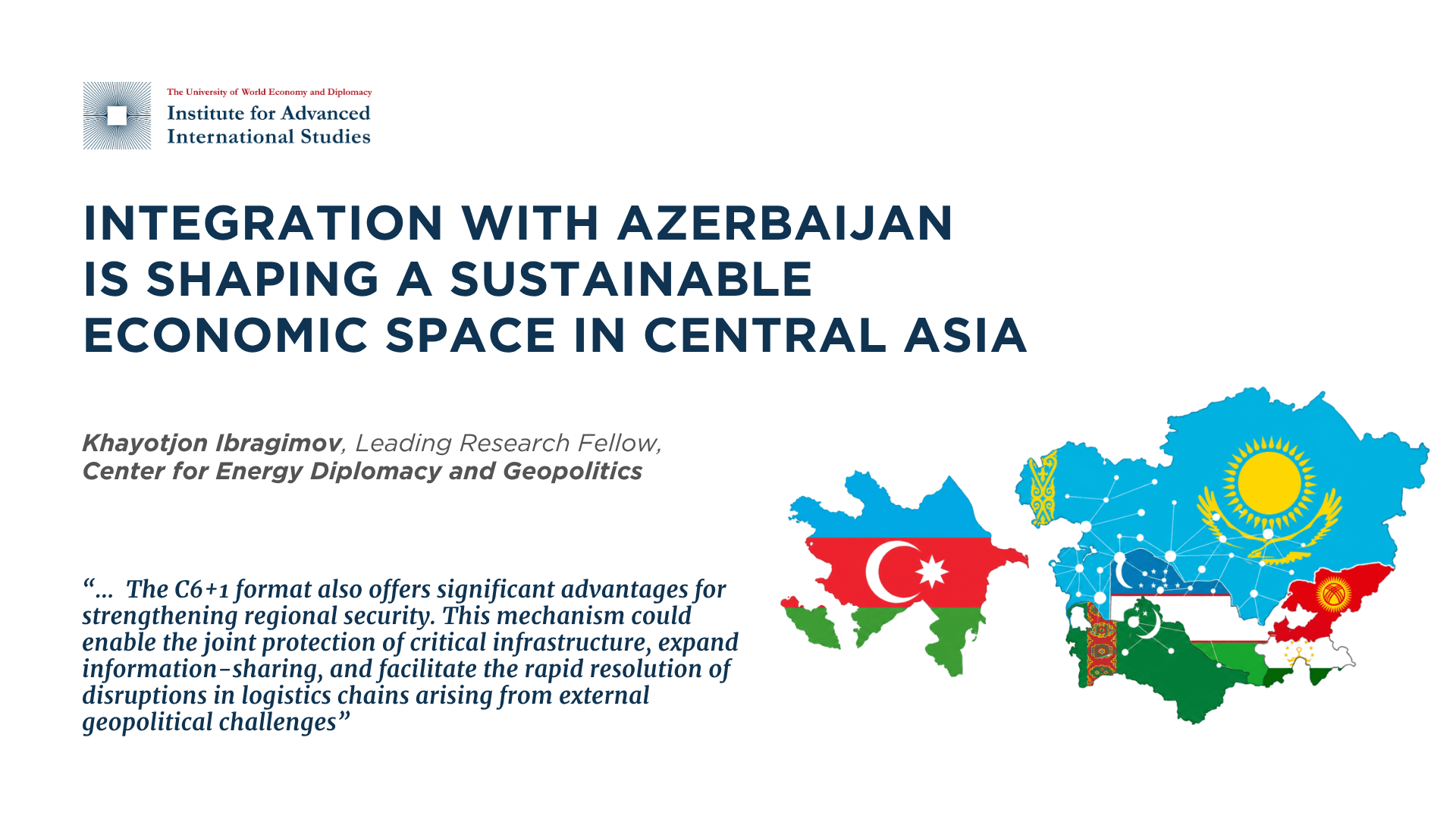
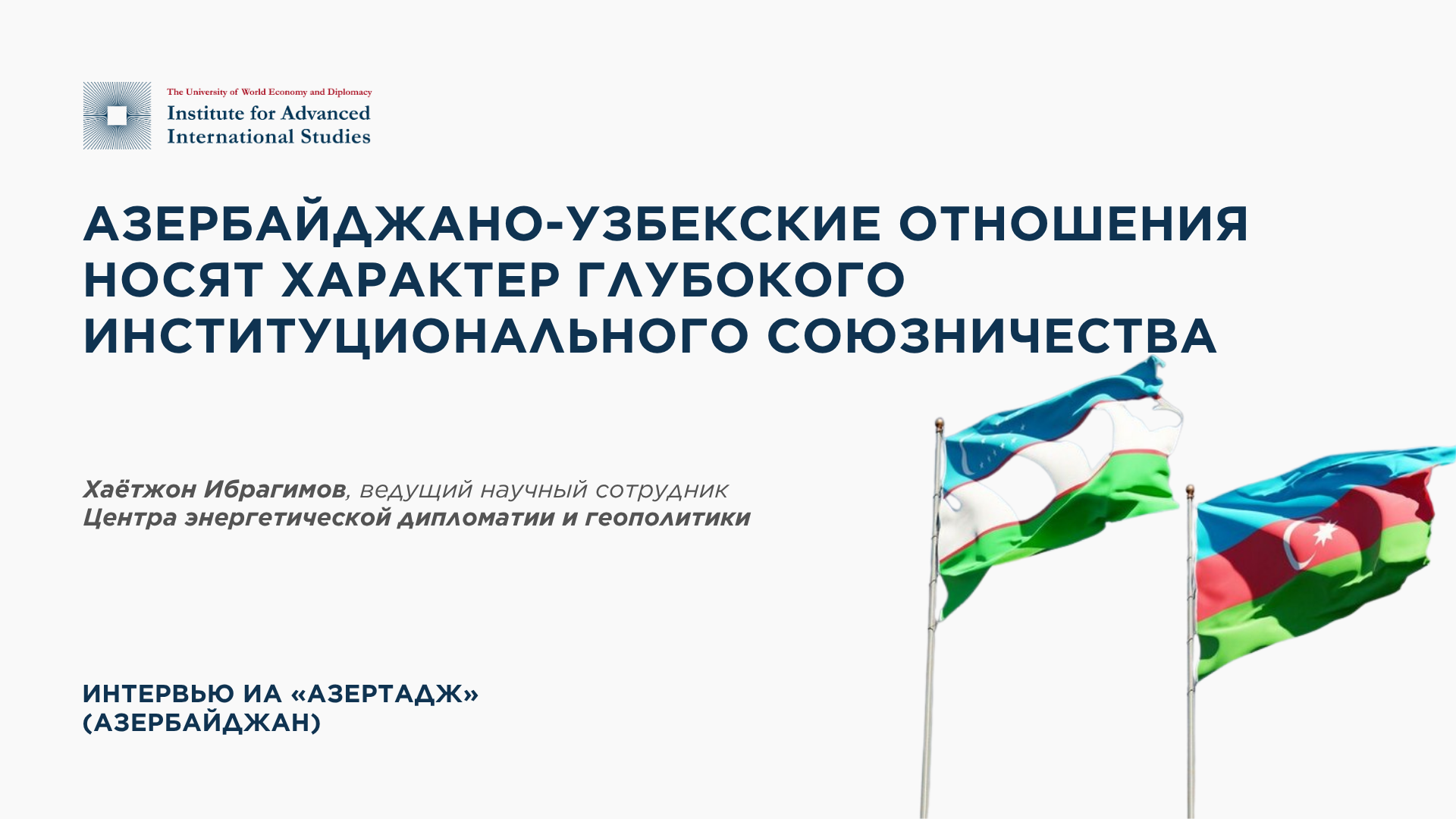
In an interview with AZERTAC, the head of the Center for Energy Diplomacy and Geopolitics, Khayotjon Ibragimov, gave a detailed assessment of the initiative of Azerbaijani President Ilham Aliyev, emphasizing its timeliness and strategic importance in the context of a complex geopolitical environment. In his opinion, the proposed course marks the transition of the Turkic states from fragmented sectoral cooperation to the formation of a single strategic security space, where economic development is organically linked to political stability. The expert placed particular emphasis on the energy dimension of cooperation, noting that deeper coordination could form a kind of “energy backbone” for Eurasia. In his view, energy sovereignty is becoming a key element of the new model of interaction in the Turkic world, influencing not only economic indicators but also the regional balance of power. In this context, energy is seen as a tool for long-term stability and strengthening collective positions in the international arena. The interview also highlighted the region’s transit potential, primarily the development of the Middle Corridor and projects to transport “green” energy from Central Asia through Azerbaijan to Europe. Khayotjon Ibragimov noted that a collective approach to protecting critical infrastructure – pipelines, power grids and transport hubs – minimises external risks and ensures uninterrupted supplies. Overall, he said, President Ilham Aliyev’s initiative forms the conceptual basis for the future development of the Turkic world as a more sustainable and influential actor in the modern international system. Read on AZERTAC * The Institute for Advanced International Studies (IAIS) does not take institutional positions on any issues; the views represented herein are those of the author(s) and do not necessarily reflect the views of the IAIS.
outputs_in

Media Appearances

12 December, 2025

Uzbekistan Enters Kazakhstan’s Oil and Gas Sector for the First Time: An IAIS Expert Commentary

The Kazakh information and analytical outlet National Business Kazakhstan has published an in-depth analytical article on the agreement between the national companies KazMunayGas and Uzbekneftegaz on joint geological exploration and potential hydrocarbon production at the Zharkyn site in the Mangystau region. The publication places the deal within the broader context of transforming energy relations in Central Asia and includes expert commentary from specialists in Kazakhstan and Uzbekistan. Within this analysis, Khayotjon Ibragimov, Head of the Center for Energy Diplomacy and Geopolitics at IAIS, provided an expert assessment of the agreement’s significance for Uzbekistan and for the regional energy architecture as a whole. His comments focus on the strategic motivations behind Uzbekistan’s participation in the project, as well as on the country’s evolving role in the regional energy security system. According to Ibragimov, the agreement is fundamentally important primarily because it marks the first time a Uzbek national company gains access to Kazakhstan’s resource base as an equal partner, rather than as a buyer or a transit participant. He emphasizes that the 50/50 partnership model reflects a new level of mutual trust and demonstrates a shift from political declarations to practical economic cooperation. In his commentary, Ibragimov also notes that Uzbekistan’s interest in such projects is driven by objective domestic factors, including rising energy demand and the strategic imperative to ensure long-term energy stability. Participation in exploration and potential production abroad is viewed as a tool for diversifying supply sources and strengthening national energy security. Furthermore, Ibragimov highlights that the deal fits into a broader regional trend in which Central Asian countries are gradually moving away from fragmented energy policies toward more coordinated forms of cooperation. In this context, energy is becoming the foundation of strategic partnership, rather than merely a sphere of commercial transactions. Read more on the National Business Kazakhstan * The Institute for Advanced International Studies (IAIS) does not take institutional positions on any issues; the views represented herein are those of the author(s) and do not necessarily reflect the views of the IAIS.