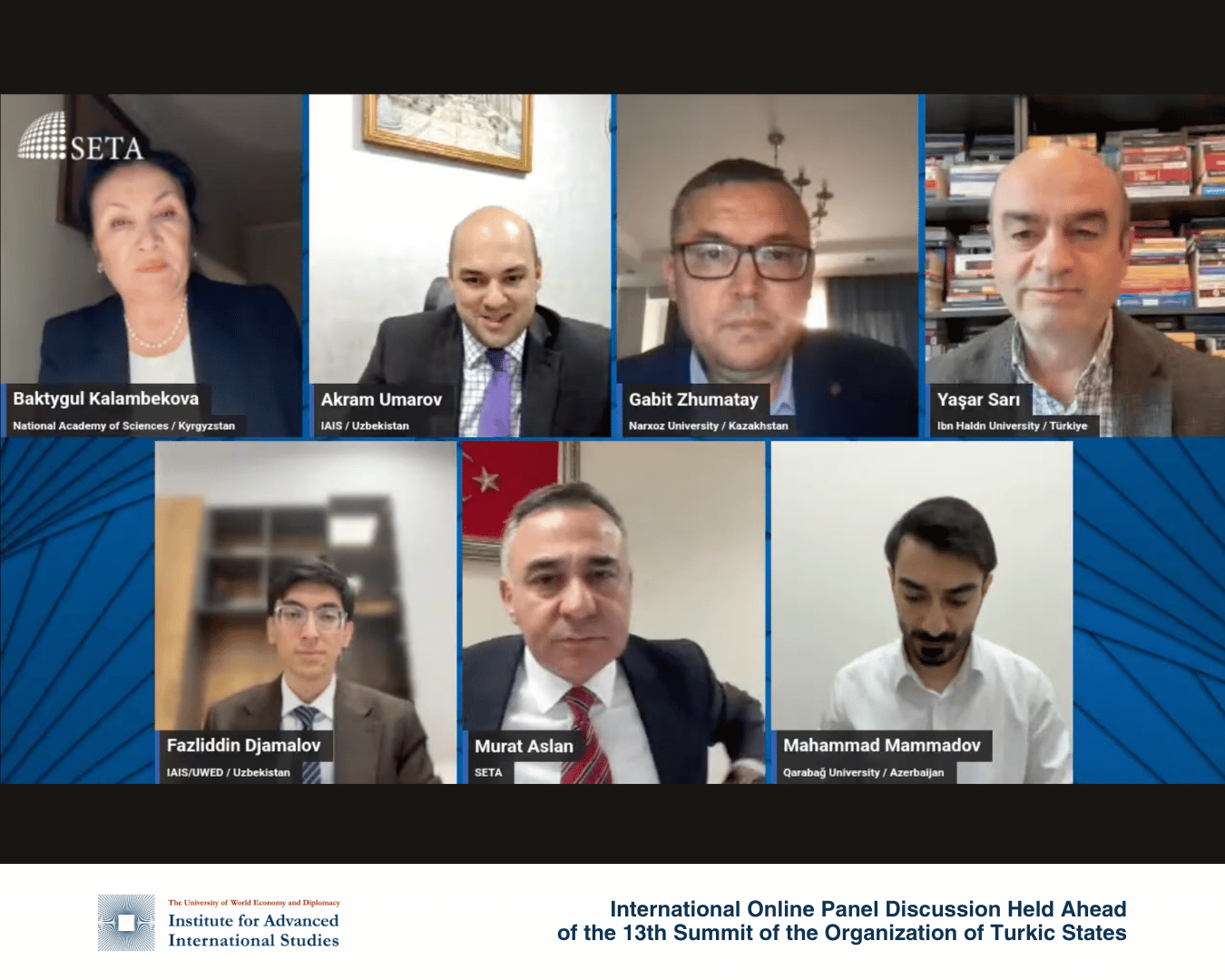
On October 28, 2026, an international online panel discussion entitled “The 13th OTS Summit: Unity and Institutionalization” was held ahead of the upcoming 13th Summit of the Organization of Turkic States (OTS) in Ankara.
The event brought together leading experts and representatives of academic institutions and think tanks from Turkic states. Participants included Murat Aslan, Associate Professor at Hasan Kalyoncu University and Researcher at the Foundation for Political, Economic and Social Research (SETA), Türkiye; Akram Umarov, Director of the Institute for Advanced International Studies (IAIS) under the University of World Economy and Diplomacy (UWED), Uzbekistan; Bektigul Kalanbekova, representative of the National Academy of Sciences, Kyrgyzstan; Yaşar Sarı, Professor at Ibn Haldun University, Türkiye; Mahammad Mammadov, Professor at Karabakh University, Azerbaijan; Gabit Zhumatay, Professor at Narxoz University, Kazakhstan; and Fazliddin Djamalov, Head of the Center for European Studies at IAIS, Uzbekistan.
The discussion focused on the transformation of the OTS from an organization primarily rooted in shared cultural and historical identity into a mechanism for strategic coordination capable of playing a more prominent role in regional and international affairs.
Participants examined prospects for strengthening the Organization's institutional capacity, expanding its functional competencies, and identifying the priorities of Türkiye's upcoming chairmanship. Particular attention was devoted to the development of the OTS Strategy for 2027–2031 and the establishment of practical mechanisms for implementing joint initiatives.
During the discussion, experts noted that the Organization's agenda currently encompasses more than 65 areas of cooperation, including transport, energy, trade, digital technologies, and the defense industry.
Special attention was given to the growing geoeconomic significance of the Turkic region amid the ongoing transformation of the international order. Participants emphasized that the development of transport and logistics corridors, access to critical mineral resources, and stronger regional connectivity are creating new opportunities for OTS member states.
In this context, the panel explored prospects for developing the Middle Corridor and aligning it with major international infrastructure initiatives, including China's Belt and Road Initiative (BRI) and the European Union's Global Gateway.
It was emphasized that these initiatives should be positioned not as competing projects but as complementary frameworks pursuing a common objective: strengthening Eurasian connectivity and diversifying international trade routes.
Another major focus of the discussion was Türkiye's upcoming chairmanship of the OTS, which coincides with the preparation of the Organization's new five-year strategy.
Participants highlighted that the coming year could prove decisive in shifting the Organization's focus from expanding the scope of cooperation to deepening institutional integration. This transition would require improving coordination mechanisms, strengthening the role of the OTS Secretariat, and establishing effective instruments for monitoring the implementation of adopted decisions.
The panel discussion provided an important platform for exchanging expert assessments and developing forward-looking approaches to the Organization's institutional development ahead of the 13th OTS Summit in Ankara.