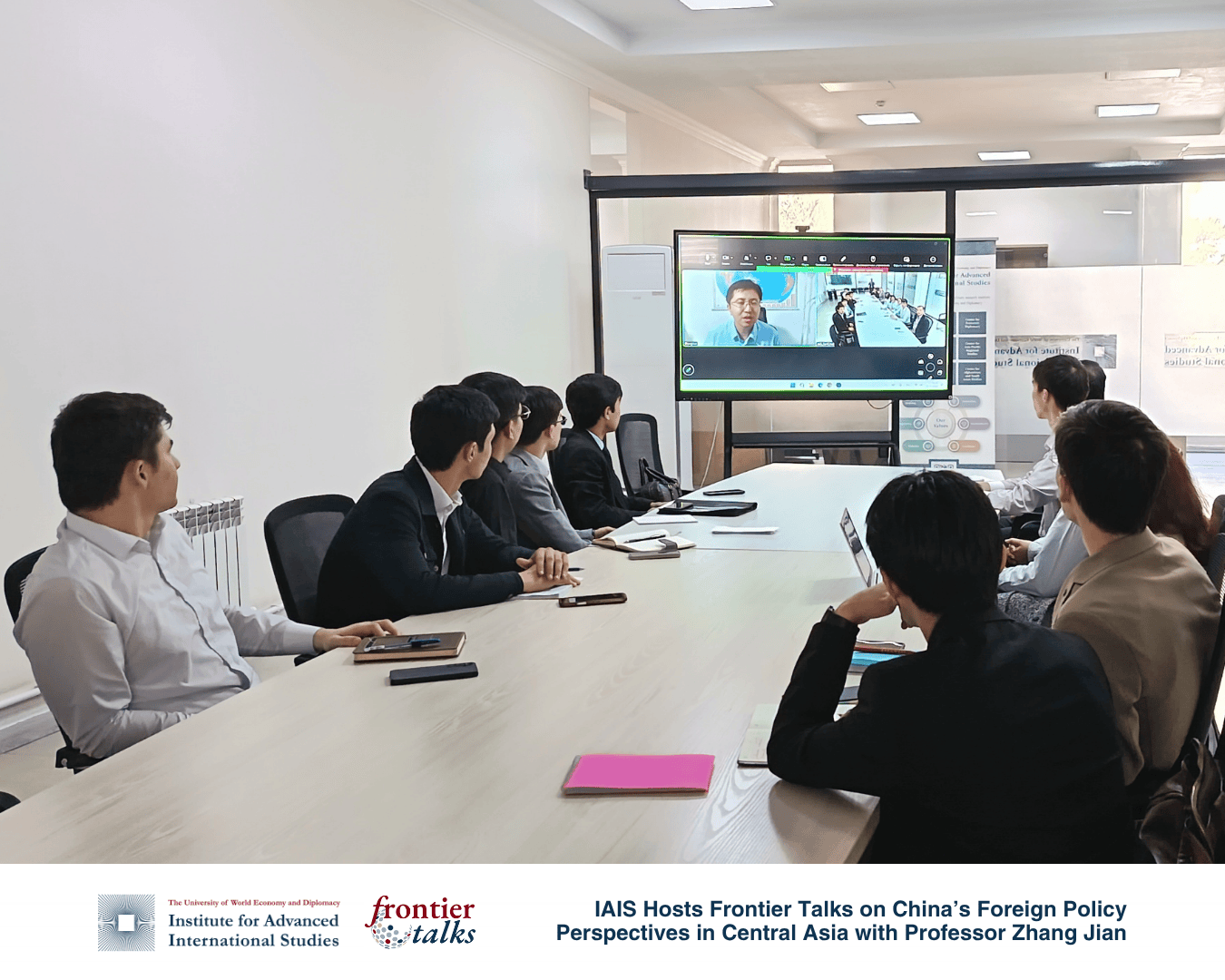
On 26 March, IAIS held a Frontier Talks lecture on the theme “Perspectives on China’s Foreign Policy in Central Asia”. The event featured Professor Zhang Jian, a distinguished scholar from the Department of Diplomatic Studies at China Foreign Affairs University, who offered an overview of Beijing’s contemporary approach to the region and its growing strategic importance in a changing international environment.
In his lecture, Professor Zhang underlined that Central Asia is assuming an increasingly important place in China’s foreign policy thinking, both in geoeconomic terms and in the context of regional stability, political trust, and long-term connectivity. He noted that China’s engagement with the region has evolved beyond trade and infrastructure, increasingly encompassing political, diplomatic, humanitarian, and strategic dimensions. Particular attention was also given to the visa-free regime, which was presented as an important sign of mutual trust and as a factor contributing to stronger business, tourism, and people-to-people ties.
A substantial part of the discussion focused on the Belt and Road Initiative as one of the key frameworks shaping China’s cooperation with Central Asian states. Professor Zhang highlighted its role in advancing transport connectivity, infrastructure development, trade, and investment, while also pointing to the strategic relevance of projects such as the China–Kyrgyzstan–Uzbekistan railway. He further outlined the broader conceptual foundations of China’s foreign policy, including the Global Development Initiative, the Global Security Initiative, the Global Civilization Initiative, and the Global Governance Initiative, arguing that these ideas increasingly inform Beijing’s cooperation with the region in the fields of development, security, intercivilisational dialogue, and humanitarian exchange.
The lecture also addressed the institutional dimension of China–Central Asia relations, with emphasis placed on the China–Central Asia format and the mechanisms of the Shanghai Cooperation Organisation as important platforms for political dialogue, security coordination, and practical cooperation. The session reaffirmed the strong interest of the expert community in the future evolution of China–Central Asia relations.