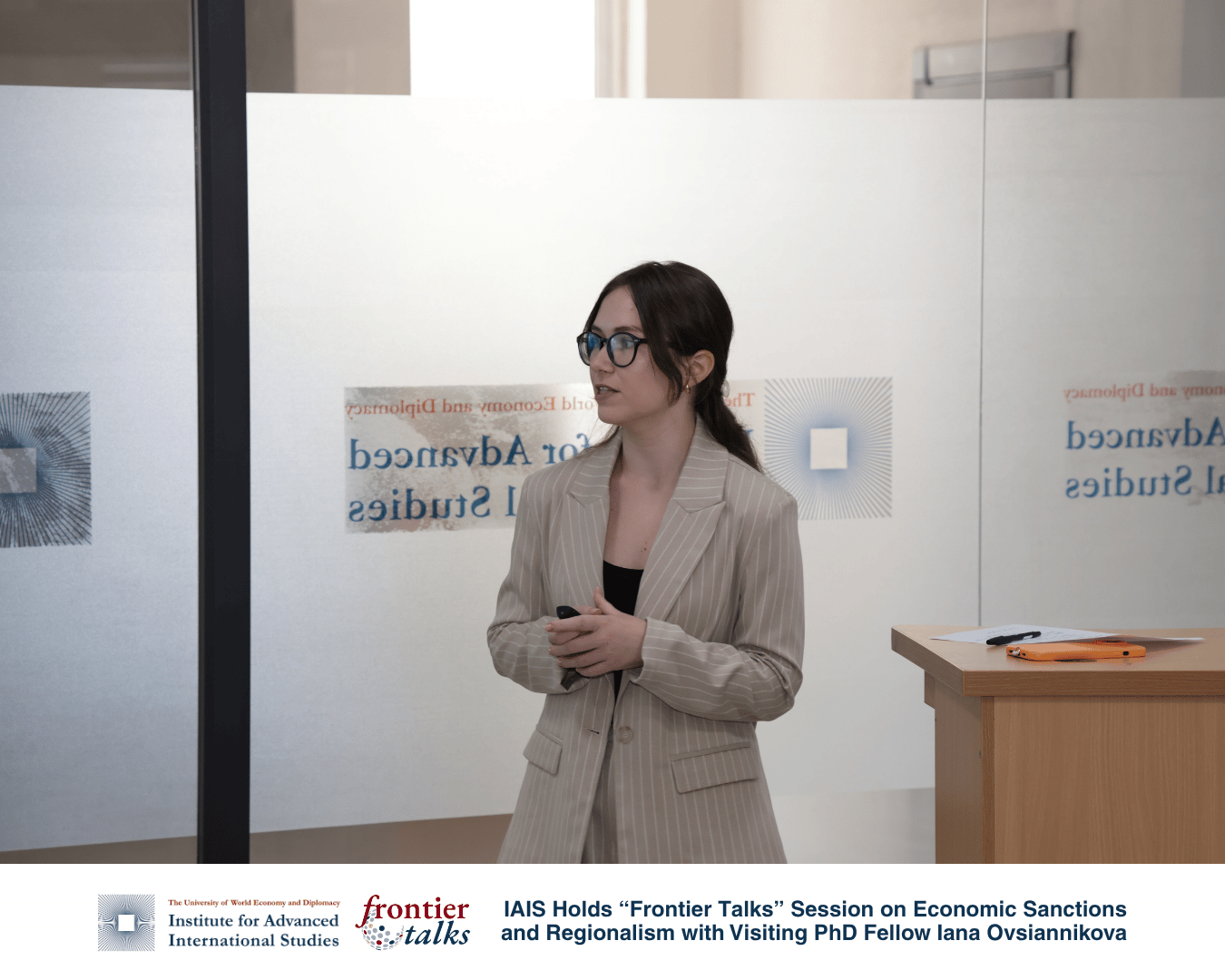
On October 2, 2026, the Institute for Advanced International Studies (IAIS) at the University of World Economy and Diplomacy held a session of its “Frontier Talks” series with Iana Ovsiannikova, PhD Researcher at Ghent University (Belgium) and the United Nations University Institute on Comparative Regional Integration Studies (UNU-CRIS). The seminar was titled “Understanding Economic Sanctions through a Regionalism Lens.”
The presentation reviewed the growing use of sanctions in world politics and the approaches to assessing their effectiveness. The speaker noted that existing literature mostly examines sanctions through a binary of sanctioning and target states, treating third countries either as sanctions busters or as normative followers of the sanctioning states, which leaves their interests and agency out of view.
The central question of the research is how regions that find themselves in the position of a third party are affected by sanctions and adapt to them. Regionalism serves as the theoretical framework, making it possible to move away from a top-down approach, to capture local practices and strategies, and to recognise regional agency. Central Asia serves as the empirical case, treated as a heuristic case for understanding the spillover effects of sanctions and regional responses to them.
In conclusion, the theoretical contribution of the work was outlined. According to the speaker, applying a regionalism approach to the study of sanctions offers a deeper understanding of their effectiveness, their governance, and the interconnection of economic actors. For the regionalism agenda, the study contributes to understanding region-making under geopolitical pressure, namely how external constraints and competing external influences shape regional agency, patterns of cooperation, and the evolution of regional order.