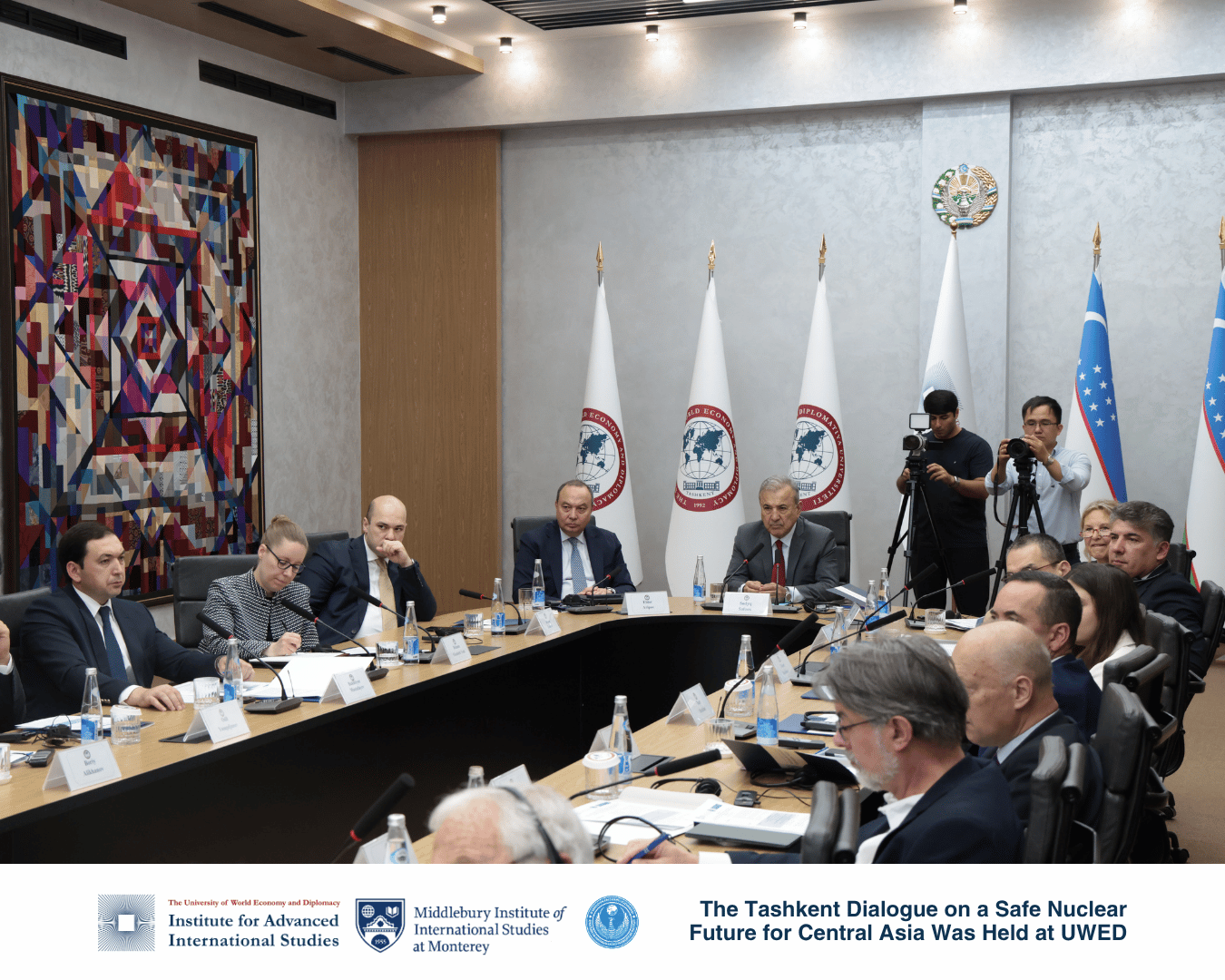
On June 26, 2026, the University of World Economy and Diplomacy (UWED) hosted the Tashkent Dialogue on a Nuclear-Weapon-Free Zone, with the theme “A Safe Nuclear Future for Central Asia: From Nonproliferation to Risk Management”. The event was organized by the Institute for Advanced International Studies (IAIS) at UWED in collaboration with the Institute for Strategic and Regional Studies (ISRS) under the President of the Republic of Uzbekistan and the James Martin Center for Nonproliferation Studies at the Middlebury Institute of International Studies in Monterey as part of the 10th anniversary Monterey Symposium, initiated by Professor Anna Vassilieva.
The dialogue focused on the transformation of Central Asia’s role in the changing global nuclear and geopolitical landscape, as well as on strengthening the nonproliferation regime, developing mechanisms for the comprehensive management of nuclear and radiological risks, ensuring safety amid the expansion of the peaceful use of nuclear energy, and enhancing the resilience of regional infrastructure to new challenges.
Welcoming remarks were delivered by the First Deputy Chairman of the Senate of the Oliy Majlis of the Republic of Uzbekistan, UWED Rector Sodyq Safoev, First Deputy Secretary of the Security Council under the President of the Republic of Uzbekistan, ISRS Director Eldor Aripov, and Prof. Anna Vassilieva, Director of the Monterey Initiative at the Middlebury Institute of International Studies.
William Clark Potter, Director of the James Martin Center for Nonproliferation Studies, delivered the keynote address. His remarks focused on Central Asia’s role amid the transformation of the global security architecture and the transition from the traditional nonproliferation regime to a more comprehensive approach to managing nuclear and radiological risks.
Representatives of relevant agencies, research institutes, and the international expert community delivered presentations on key topics, including the UZATOM Agency under the Cabinet of Ministers of the Republic of Uzbekistan, the Institute of Nuclear Physics of the Academy of Sciences of Uzbekistan, as well as experts in the fields of international security, nuclear nonproliferation, and environmental sustainability.
During the thematic presentations, participants discussed ensuring safety in the context of the development of peaceful nuclear energy and the nuclear power industry, including requirements for nuclear and radiation safety at all stages of the life cycle, the prevention of accidents and technological risks, the development of national regulatory bodies, and cooperation with the IAIE. Special attention was given to the management of nuclear and radiological risks as Central Asia transforms into a transportation and logistics hub.
The Tashkent Dialogue served as an important expert forum for discussing the future of a nuclear-weapon-free zone in Central Asia and for developing practical approaches to ensuring a safe, sustainable, and responsible nuclear future for the region.