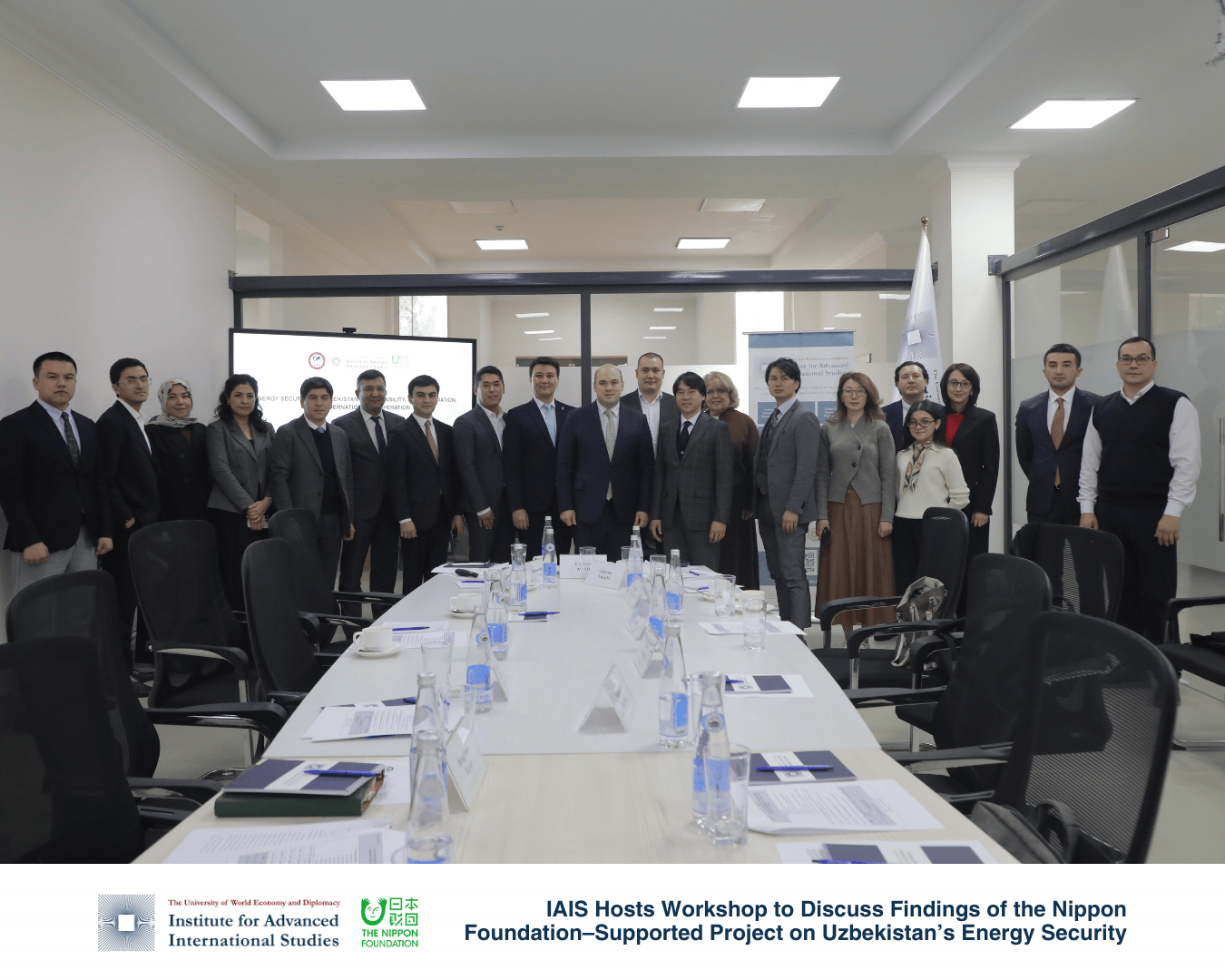
On 6 February, the Institute for Advanced International Studies (IAIS) held a workshop entitled “Energy Security of Uzbekistan: Sustainability, Transformation and International Cooperation”. The event was organised as an expert dialogue platform to discuss the key findings and analytical outcomes of the project of the same name, implemented with the support of the Nippon Foundation.
The workshop brought together government officials, international partners, researchers, and policy experts to exchange views on Uzbekistan’s ongoing energy transition and its implications for sustainable development, long-term resilience, and regional cooperation. Particular attention was devoted to strengthening national energy security through the diversification of energy sources, infrastructure modernisation, and the expansion of international partnerships.
Opening remarks were delivered by Akram Umarov, First Vice-Rector of UWED and Director of IAIS, alongside Arikawa Takashi, Executive Director of the Nippon Foundation, and Umid Mamadaminov, Deputy Minister of Energy of the Republic of Uzbekistan. Speakers underlined the importance of evidence-based policy dialogue in supporting Uzbekistan’s strategic energy transformation and enhancing cooperation with international stakeholders.
The programme included two thematic panels addressing the most pressing dimensions of Uzbekistan’s energy agenda.
The first panel focused on the role of renewable energy sources in strengthening energy security and ensuring reliable access to energy across regions. Discussions explored institutional and regulatory challenges, the balance between economic growth and social sustainability, and the broader impact of energy constraints on employment and quality of life.
The second panel examined the strategic role of nuclear power in Uzbekistan’s long-term energy transition, including its implications for regional energy stability, infrastructure development, and energy efficiency. Speakers also reflected on international experiences, including those of Japan and Hungary, in managing the social and institutional aspects of energy policy reforms.
The workshop concluded with a summary of key discussion points and an exchange of final comments, reaffirming IAIS’s commitment to advancing expert-driven research and policy dialogue on Uzbekistan’s sustainable development priorities.