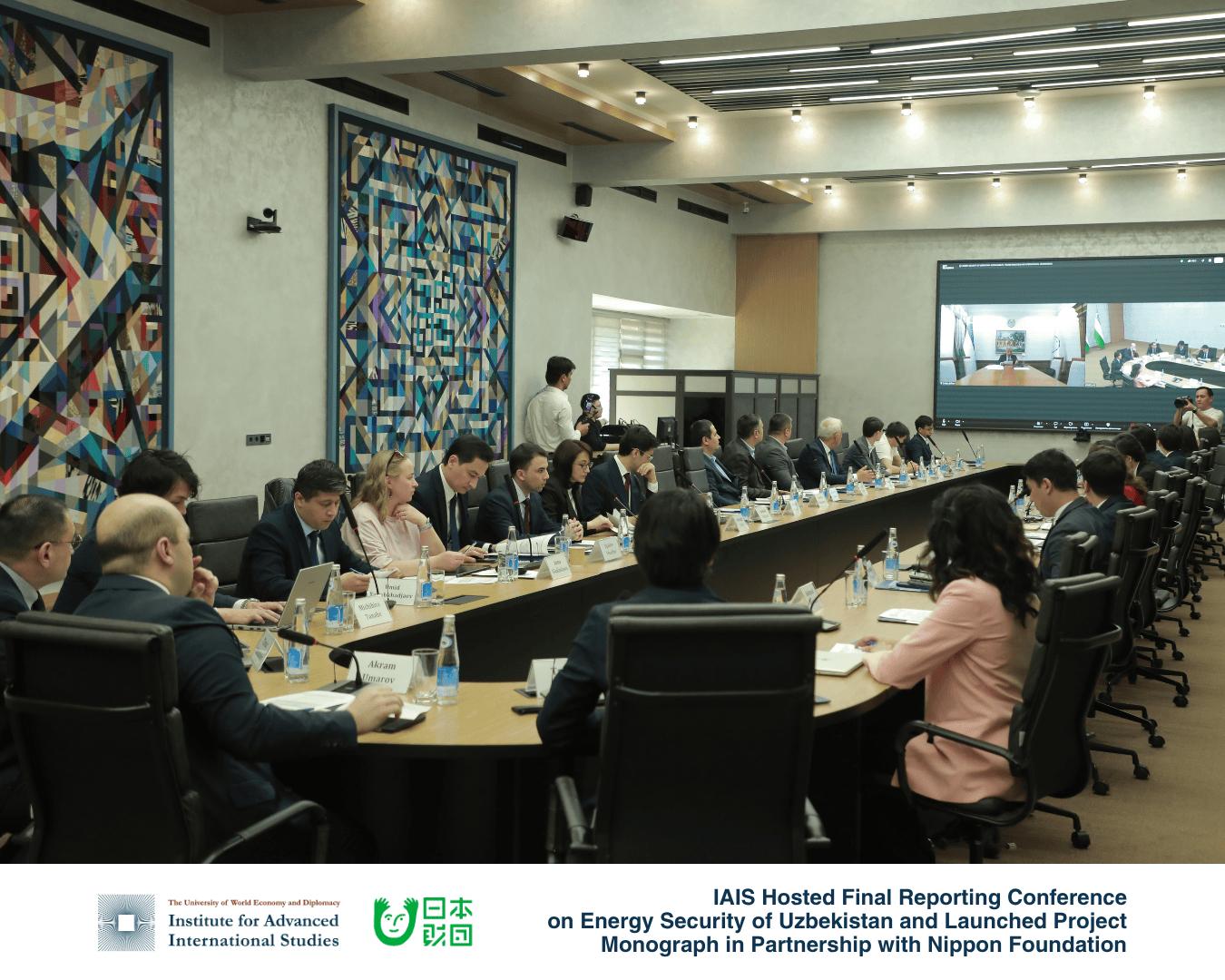
On 10 April, the Institute for Advanced International Studies at the University of World Economy and Diplomacy hosted the final reporting conference entitled “Energy Security of Uzbekistan: Sustainability, Transformation and International Cooperation”. The event served as the concluding presentation of the research project supported by the Nippon Foundation, the official launch of the project monograph, and a platform for discussing the next phase of analytical and policy-oriented work on Uzbekistan’s energy future.
The conference brought together representatives of government institutions, research centres, international partners, and the wider academic community to examine the ongoing transformation of Uzbekistan’s energy sector and its implications for sustainable development, economic resilience, and regional cooperation. Particular attention was devoted to evidence-based policy dialogue on diversification of energy sources, institutional reforms, infrastructure modernisation, and international cooperation in strengthening national energy security.
The opening session, chaired by Dr. Akram Umarov, First Vice Rector of UWED and Director of IAIS, included remarks by Prof. Sodyq Safoev, First Deputy Chairman of the Senate of the Oliy Majlis and Rector of UWED, Mr. Takashi Arikawa, Executive Director of the Nippon Foundation, and Prof. Timur Dadabaev, Vice Rector for Research and Innovation at UWED. Dr. Khayotjon Ibragimov, Project Manager, delivered a keynote address, which outlined the main outcomes of the project and its broader relevance for Uzbekistan’s energy policy agenda.
The first panel, devoted to the diversification, sustainability, and transformation of Uzbekistan’s energy sector, explored the legal and regulatory dimensions of reform, tariff and subsidy policy, investment incentives, the scaling up of renewable energy, and the governance and safety aspects of nuclear energy development.
The second panel addressed the wider regional dimensions of energy security, with a focus on cross-border resilience and interdependence in Central Asia. Participants discussed regional electricity market integration, Afghanistan’s evolving role as a trade and transit partner, broader Central Asia–Middle East linkages, and the implications of developments in neighbouring energy markets.
The final panel focused on future directions in the water–energy nexus and climate resilience. Discussions examined the interconnection between water and energy security in Central Asia, the implications of climate change for regional stability, transboundary resource management, and the strategic risks associated with environmental pressures.
The conference underscored the importance of sustaining analytical cooperation and policy dialogue on the future of Uzbekistan’s energy sector. As both a final reporting event and a strategic transition point, the conference marked an important step in advancing discussion on energy diversification, regional interdependence, and long-term resilience in Uzbekistan and Central Asia as a whole.