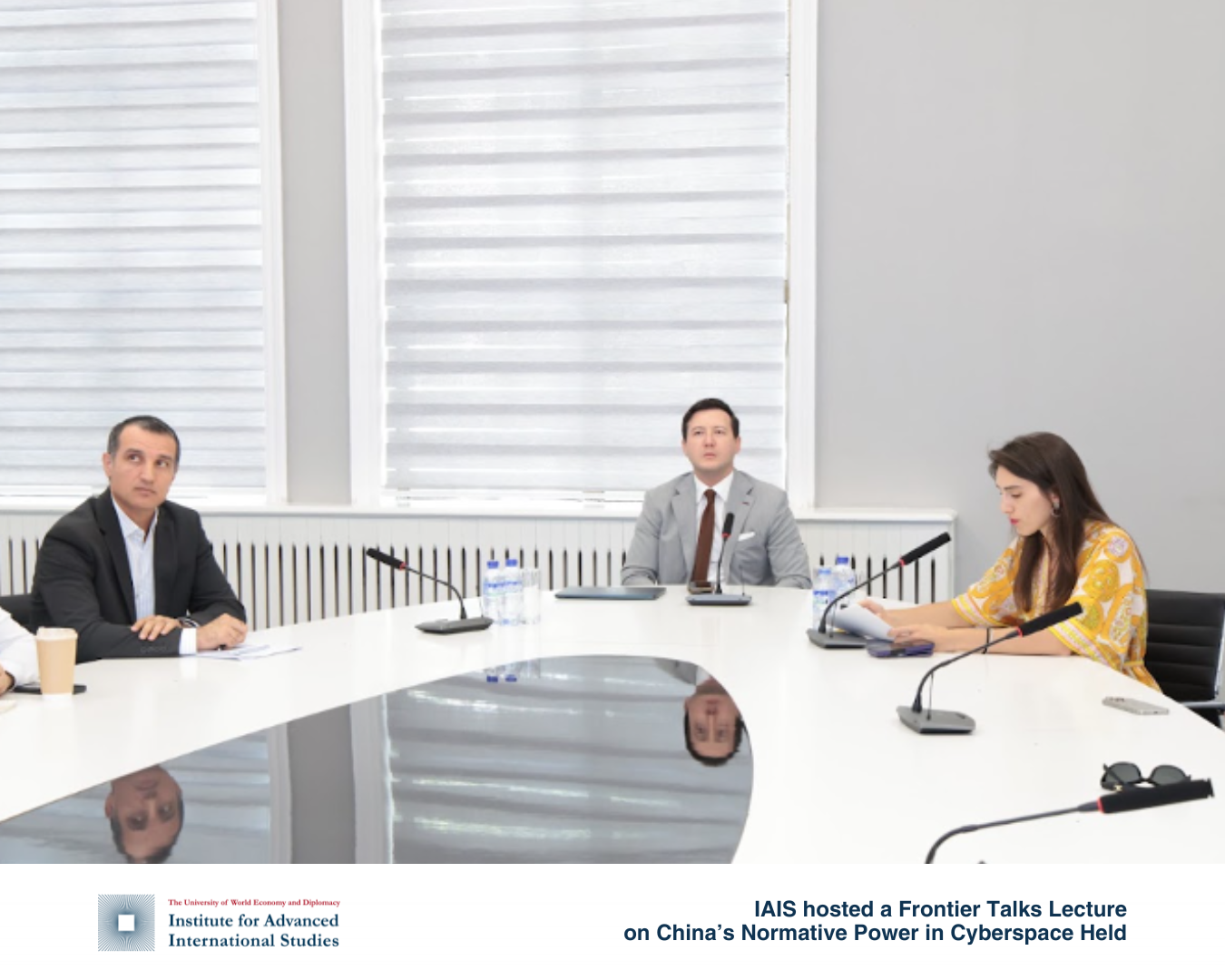
On 22 September, the University of World Economy and Diplomacy (UWED) hosted a lecture by Professor Maria Adele Carrai of the University of Oxford, a visiting scholar at IAIS under the Fulbright Program, on “China’s Normative Power in Cyberspace”. The event was attended by staff members of the Institute for Advanced International Studies, as well as UWED faculty members and students.
The lecture focused on the question of how China seeks to leverage its economic, technological, and political capabilities to shape international norms and rules governing the digital domain. Professor Carrai emphasized that China’s normative influence should not be viewed solely as a unilateral export of its own model of digital governance. Other states are active participants in this process, adopting, adapting, or rejecting particular Chinese approaches. In this regard, China’s normative influence represents a complex and multifaceted process of interaction rather than a straightforward transfer of norms.
Particular attention was devoted to the concept of cyber sovereignty, under which cyberspace is regarded as an integral component of state sovereignty. Key elements of this approach include the prioritization of national security, state control over data and digital infrastructure, data localization, licensing requirements, security assessments, and the accountability of digital platforms. The lecture also addressed the implications of the emerging digital order for international business. Divergences between regulatory frameworks create new challenges for companies in terms of compliance, data governance, supply-chain management, and the selection of jurisdictions in which to conduct their operations.
At the conclusion of the lecture, students and other participants raised a number of questions concerning the future development of digital regulation, cyber sovereignty, and China’s role in shaping international norms. Professor Carrai provided detailed responses to the questions and engaged in a substantive discussion with the participants.
Overall, the event generated considerable interest among UWED students, faculty members, and staff. It provided a valuable platform for discussing the transformation of the international digital order and China’s growing role in shaping its emerging norms and regulatory frameworks.