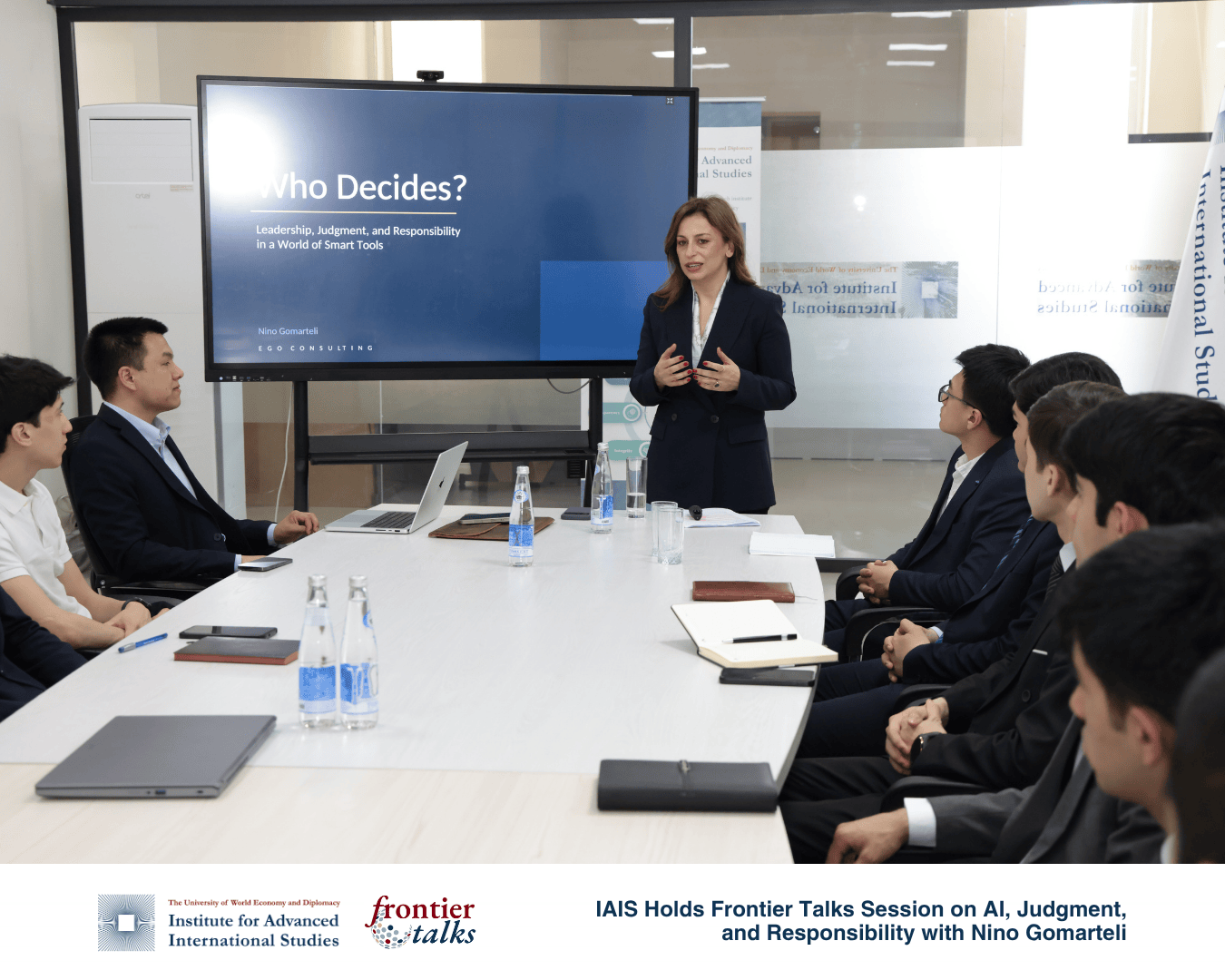
On 1 April, the Institute for Advanced International Studies hosted a new session of its Frontier Talks series entitled “Who Decides? Leadership, Judgment, and Responsibility in a World of Smart Tools.” The event featured Nino Gomarteli, who delivered an engaging lecture on the growing role of artificial intelligence in shaping decision-making, critical thinking, and individual responsibility.
The discussion was held in the context of the rapid expansion of AI technologies across academic, professional, and policy environments. In this regard, the seminar focused not only on the capabilities of AI systems, but more importantly on their impact on human judgment, intellectual independence, and the quality of decision-making in an increasingly automated world.
In her lecture, Nino Gomarteli emphasized that while AI tools are becoming more sophisticated, the central challenge lies in how individuals engage with them. Particular attention was devoted to the concept of “false confidence,” whereby information that appears structured, confident, and well-sourced may nevertheless be inaccurate. In this context, she underlined the distinction between confidence as a tone and truth as a process, highlighting the importance of verification, contextual understanding, and critical reflection.
A key part of the session introduced the E.G.O. framework — Explore, Grow, Own — as a practical approach to responsible AI usage. The framework encourages users to first clarify their own understanding before engaging with AI tools, to use such tools to challenge and refine their thinking, and ultimately to take full ownership of their outputs by ensuring they can explain, defend, and take responsibility for their ideas.
The seminar also addressed the broader implications of AI use in academic and professional settings, including the risks of over-reliance on automated outputs, the erosion of independent thinking, and the temptation to prioritize speed and polish over substance and originality. Participants were encouraged to view AI not as a substitute for thinking, but as a tool for strengthening analytical capacity and intellectual discipline.
The session concluded with an interactive discussion, reflecting strong interest among participants in the ethical, cognitive, and practical dimensions of AI use. The event reaffirmed the importance of fostering critical thinking and responsible leadership in the age of rapidly advancing technologies.