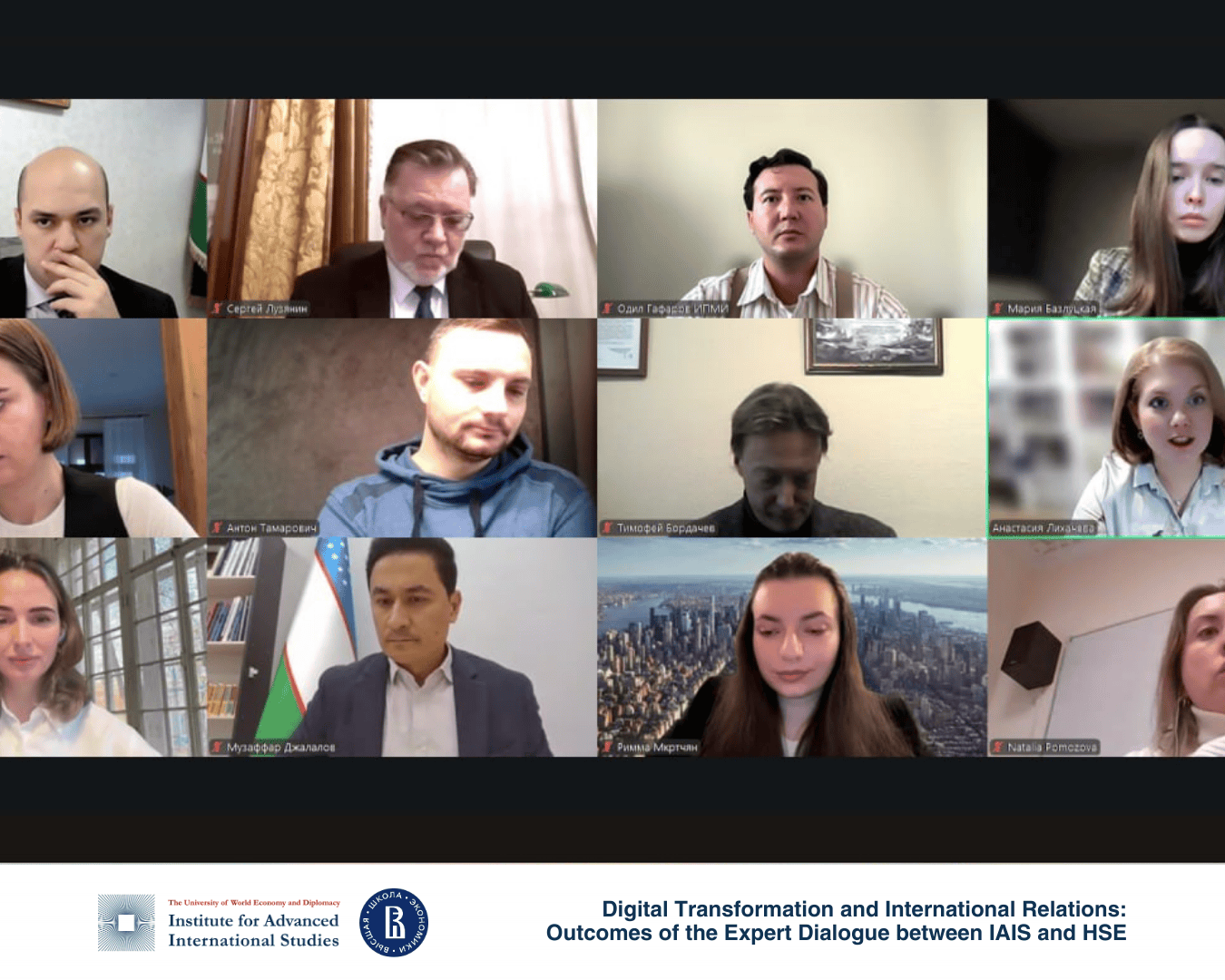
On 25 November, an online roundtable titled “Artificial Intelligence and International Relations: Global Trends, Regional Opportunities, and Academic Cooperation” was held, jointly organised by the Institute for Advanced International Studies (IAIS) at the University of World Economy and Diplomacy and theNational Research University Higher School of Economics (HSE University).
The dialogue brought together experts and representatives of the academic community to discuss the strategic approaches of both countries to digitalisation and the use of artificial intelligence (AI) in governance, economic modernisation, and education.
During the first session, participants examined the integration of AI into public administration and national development strategies. The Uzbek side outlined plans to strengthen digital infrastructure, including the launch of aa new supercomputer and applied AI projects across key sectors such as energy, agriculture, and education. Emphasis was placed on advancing human capital through national training initiatives aimed at preparing specialists in the field of AI and promoting international collaboration with global technology institutions.
Experts from Russia presented the country’s experience in building a data-driven governance model and developing a unified regulatory environment for AI deployment. It was noted that by 2030, the majority of administrative decisions in Russia are expected to be made based on data, reflecting a shift towards a citizen-centric governance paradigm. The discussion also highlighted the growing role of private technology companies as contributors to the development of national AI ecosystems.
The second session focused on legislative and ethical aspects of AI governance, addressing issues of technological sovereignty and international cooperation. Both sides agreed on the importance of establishing ethical frameworks that balance innovation with human rights and cultural diversity. Attention was given to the risks of emerging “technological bubbles” that could divide the global AI landscape into isolated blocs, as well as to the need for academic partnerships to prevent such fragmentation.
The roundtable concluded with a discussion on the socio-economic implications of AI. Participants stressed that AI represents both an opportunity for development and a challenge for labour markets, calling for reforms in education systems to equip future professionals with adaptive digital competencies.
The organisers confirmed their intention to maintain regular expert exchanges, expand joint research projects, and foster student initiatives that promote technological innovation and strengthen cooperation between Uzbekistan and Russia in the digital era.